

Good morning, friends. The long-awaited Thunderdome: Iran War Edition will run on Friday. Thunderdomes are for paid subscribers only, so now would be a good time to sign up.
A brief local racing update: Mini Danger Girl ran the divisional at Grattan this weekend. She was the only 2nd-generation (105hp) SCCA Sports Racer in a field with two 1st-gen cars (90hp) and ten 3rd-gen (135hp) cars. She was able to outperform expectations a bit and ran between 7th and 9th place in all three races despite two spins and a contact incident. The 3rd-gen car she hit (from behind on a straight, oddly enough) took full responsibility and then gave her some parts from his 2nd-gen car as a friendly gesture. The most important part about the whole weekend, really, was that I had a chance to eat at “Mr. Burger” in Grand Rapids. Not only was the meal insanely great, the whole restaurant is essentially unchanged from the Seventies. It was like being a child again. 100% recommended.
A brief Pikes Peak update: This year every single finisher beat Jonny Lieberman’s time. Every single one. Including the off-road trophy Jeep and the 70-year-old Japanese fellow in his 230-horsepower vintage Nissan Pulsar. If you ask Jonny, he will tell you he was racing in the fog, but the in-car makes it pretty plain that his visibility was good enough for how fast he was going, which can best be described as “slower than a senior citizen in a Nissan Pulsar”.
Speaking of racing:
He forgot to call him “mate”
”I feel like I was in a fistfight the whole race,” Kevin Magnussen said, regarding the street race at Coronado, but it was almost literally true, as noted moron Noah Gregson felt compelled to confront K-Mag after the checkered flag flew. Gregson had been holding Magnussen up, deliberately so, so the former McLaren et al. F1 driver went ahead and put him into the wall. The interactions are worth watching:
Magnussen set fast lap in his NASCAR debut, by seven-tenths over the winner, which is admirable. Up front, it was 23XI youngster Corey Heim, who pulled ahead of his teammate Bubba Wallace and also received some unusual courtesy from teammate Tyler Reddick in the middle of the race; Reddick could have made a pretty hard but NASCAR-permitted move, but failed to do so. No worries; he still leads the series overall.
It would be nice to see Magnussen in NASCAR full-time; like Juan Pablo Montoya, K-Mag is a useful combination of Euro talent and American attitude. Give the man a Buc-ee’s sponsorship and set him loose!
Even Noah Gregson might have been faster
Not content with regularly humiliating Porsche at the Burger King Ring, Xiaomi is now running their YU7 around the place without a driver. To my immense sorrow, the vehicle is top-speed-limited to 140kph, or 87mph. It could have done better with a longer leash. and no doubt will do so once all parties involved agree to allowing it a higher maximum speed.
Is this an impressive feat? I would say “nah”, but not because the time was modest. Racetracks are tailor-made for autonomous vehicles, being limited-access roadways where everyone is going the same direction. All of the various takes on “the trolley problem” faced by autonomous vehicles in the real world simply don’t exist at the Ring. At any point in the past decade, Elon could have sent a Model S over to do the track much faster than 10 minutes and 29 seconds.
That being said, I like the idea of the Ring having “autonomous days” with no restrictions whatsoever. Let the batteries hit the floor — and let’s hope they don’t burn down a significant percentage of the surrounding forest in the process.
They have to go back, but they probably won’t
”There is no mass migration to Europe,” claims the Iraqi-born Swedish member of the EU Parliament Abir Al-Sahlani. Given that the EU has somewhere between 64 and 87 million foreign-born residents in its total of 450.6 million people, and is accepting close to 3 million migrants a year, one wonders what would have to happen for Al-Sahlani to consider it a “mass migration”. By her standards, the Norman Conquest was a high-school club summer holiday.
Al-Sahlani is also in the news for claiming that she felt “unsafe” after the EU Parliament voted for some remarkably mild measures regarding “return hubs” for migrants. Prior to this vote, there was essentially no such thing as an illegal migrant in the EU. Sure, you might arrive illegally, but you could not be deported unless your original country agreed to have you back and you agreed to your original country’s return process.
With this vote and the ratification to (it is hoped) follow, the EU can establish “migrant return hubs” in third-party countries. So if you migrate illegally from Senegal, the EU doesn’t have to get both you and Senegal to agree on the conditions of your return. Instead, they can ship you to a country outside the EU and basically drop you off there. This is the only sane way for a sovereign entity to maintain its borders, because the other alternatives aren’t internationally legal. Germany can’t just deport a Senegalese person to Senegal, because that violates Senegal’s borders. Nor can they just throw the Senegalese person over the nearest EU border to, say, Turkey, because that, too, is an international violation.
The way it will work in practice, if everyone agrees, is that Germany will pay Uganda or Tunisia to accept the migrants, and then they become Uganda’s or Tunisia’s problem. This has a lot of Eurocrat types upset because they point out, correctly, that Uganda or Tunisia could take the money then march the refugees out and machine-gun them, the way East Germany used to machine-gun Europeans who wanted to cross the Berlin border. This sounds awful until you remember that the EU has astonishingly broad rules to permit legal migration. You really gotta try hard in order to enter the EU without someone, somewhere, managing to successfully toss a permit at you. It’s like buying weed in Michigan. It’s also true that illegal migrants in the EU can always just leave if they want. This “return hub” setup will be limited to people who won’t have it any other way.
It’s also certain that various coalitions and parties, like Renew Europe, will do their best to throw legal monkeywrenches into the works, the same way that every MS-13 gang rapist, animal torturer, and fentanyl spiker in the United States somehow becomes the pet project of some federal judge who discovers a new Constitutional right to shoot innocent women dead because they are stupid enough to walk on a public pier.
Regardless, I think the sentiment behind the vote is admirable. If you don’t have borders and laws, you don’t have a country. This was settled bipartisan policy in the United States as recently as Bill Clinton’s second Presidential term; we should devote some serious thought to wondering how and why that changed.
Speaking of getting into Europe
You can’t get the book in the United States, perhaps because of the nature of its allegations, but people are talking about it nonetheless. Everybody Loves Our Dollars: How Money Laundering Won is the new book from Oliver Bullough, and its cover gives an unequivocal hint as to the content:
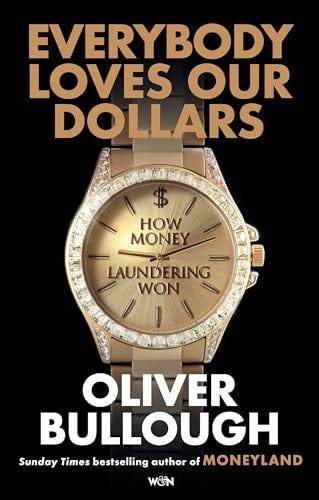
Bullough asks a police contact about luxury watches, which are a notoriously effective way of moving monetary value. ‘I reckon the luxury watch trade is 80 per cent money laundering. Why wouldn’t it be? You can carry a huge, big bag of money and be very noticeable, or have the same value strapped to your wrist, and be completely anonymous.’
This is “money laundering” in the sense of “getting cash into Europe”, as opposed to the “Ozarks” sense of “turn illegally sourced cash into taxable, ostensibly legitimate income”, so it won’t resonate as much with American readers. But there are American examples in the book:
Bullough gives the example of a Mexican drug dealer who smuggles product across the border to the US. The drug in question would once have been marijuana, then cocaine, and is now likely to be fentanyl, which is cheap to manufacture and easy to conceal. The drugs are sold in the US for cash, which is used to buy, say, agricultural equipment. The machinery is shipped to Mexico, invisible as part of the $2.2 billion of physical goods that cross the border every day – that’s a total of $800 billion a year. Back home, it is sold by the drug dealer for pesos, which are now clean. The gangsters have exchanged drugs for clean peso bank deposits, without any record of the kinds of financial transaction that the AML/KYC/CTR/SAR apparatus is intended to detect.
In theory, those agricultural-equipment dealers should be reporting cash transactions to the Federal Government — but unless someone is stupid enough to send the same buyer to the same dealer over and over again, what can be done about it? Cash is legal tender. You’re allowed to pay a million dollars in cash for a tractor. You’ll be reported to the IRS, but if you are operating under a fake social security number this is an empty penalty.
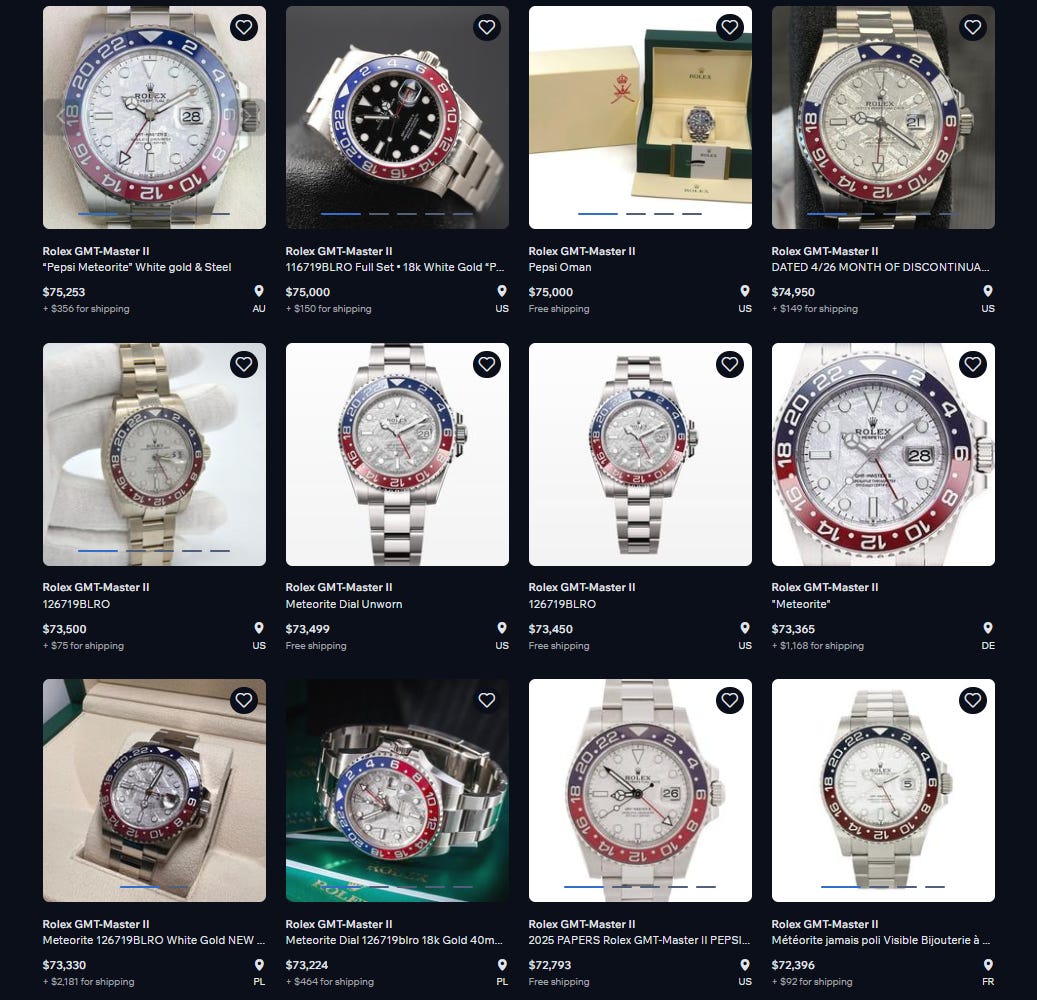
Ever since reading about Bullough’s book I’ve been wondering: what are the most likely money-laundering watches? Ideally they would be items with tremendous global appeal and some pent-up buyer demand. They should also have strong resale value. I mean, you theoretically could launder money by walking into a Breitling store, buying a Navitimer for $47,900, then selling it to a European jewelry dealer for the $22k it fetches as a used watch, but that feels like an unnecessary cost of doing business.
The hot ticket here would almost certainly be steel Rolexes and Pateks. Take, for example, the Patek 5726-1A-014. MSRP is $62,766. Street price is between $135k and $160k depending on the dealer. What you want here is to deal with someone on 47th Street in NYC who paid $100k for the watch and has it listed for $140k with an expectation of selling it at $135k. He’d rather not pay tax on that $35k markup, so you give him $130k cash, he reports a sale at $115k, and he pockets the other $15k as unreported gains. Then you go to Europe and sell it for $120k net as a private citizen. Or something like that.
This business model works best if you deal in a fairly limited variety of items. You don’t want to be a watch dealer; you want to be a drug dealer or, as they say in the rental business, similar. You want new-in-box items that are easy to validate or authenticate. It helps if the items in question are common enough that they don’t excite any particular interest — even a novice customs agent recognizes a Richard Mille.
So yeah, steel Rolexes and Pateks. This doesn’t account for all of the bump over MSRP enjoyed by those pieces, but it doesn’t help matters, either. You’re essentially bidding against people who have no upper constraint to their finances, like a single black guy trying to buy a house in Frisco, TX against entire overseas families with 100% FHA loans.
The existence of a mechanism always implies the existence of alternate ways to use or misuse that mechanism. So what’s required here is that I buy up a ton of the Watchdives Faquanaut at $109 or thereabouts, then create a fake demand for them in Europe, at which point I can sell them for $999 each to money launderers. It’s true that this is not a well-thought-out business plan, but neither was WeWork.
On behalf of Japan, we apologize for Tennessee
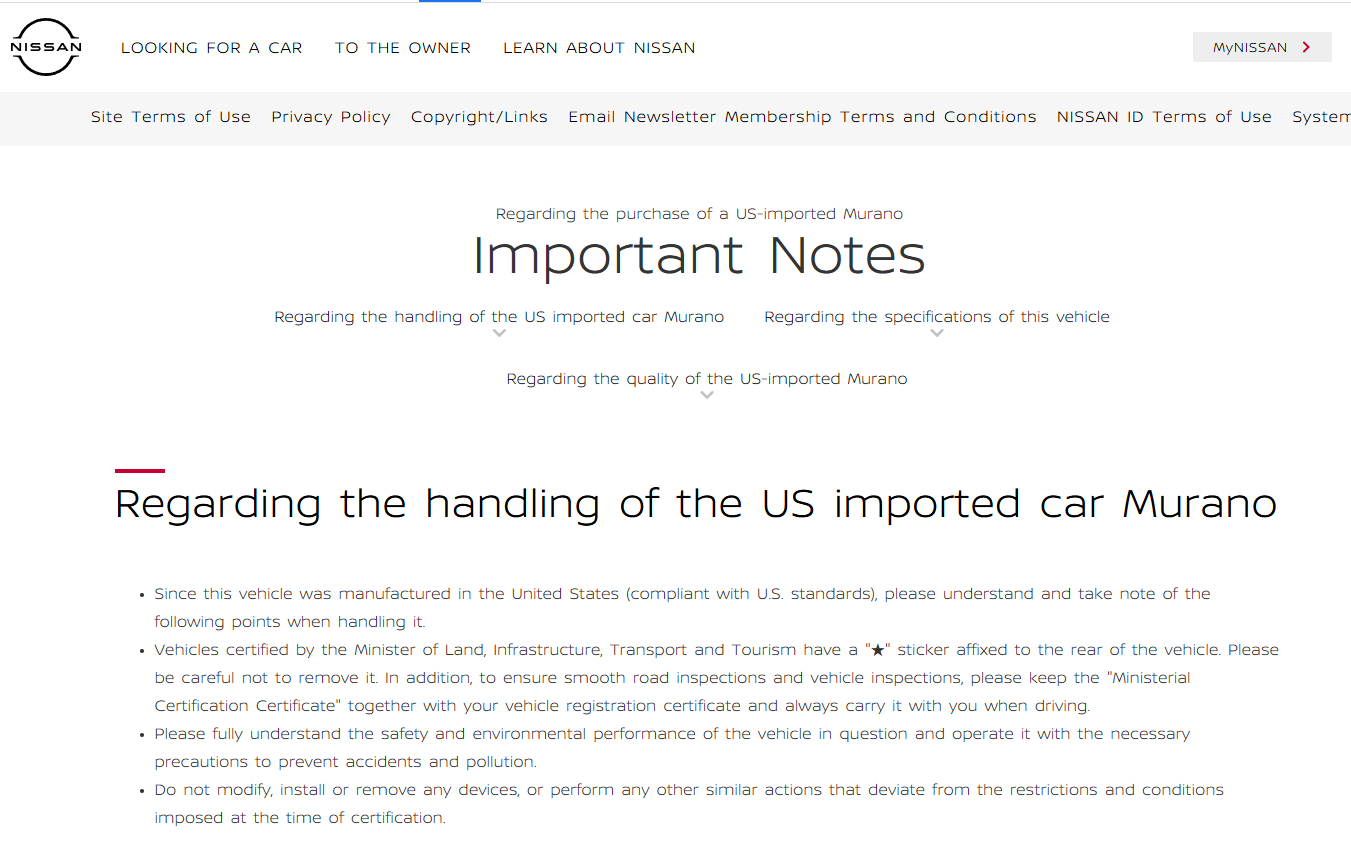
Much is being made of the disclaimers surrounding Nissan Muranos being imported to Japan from the automaker’s Smyrna, TN operations:
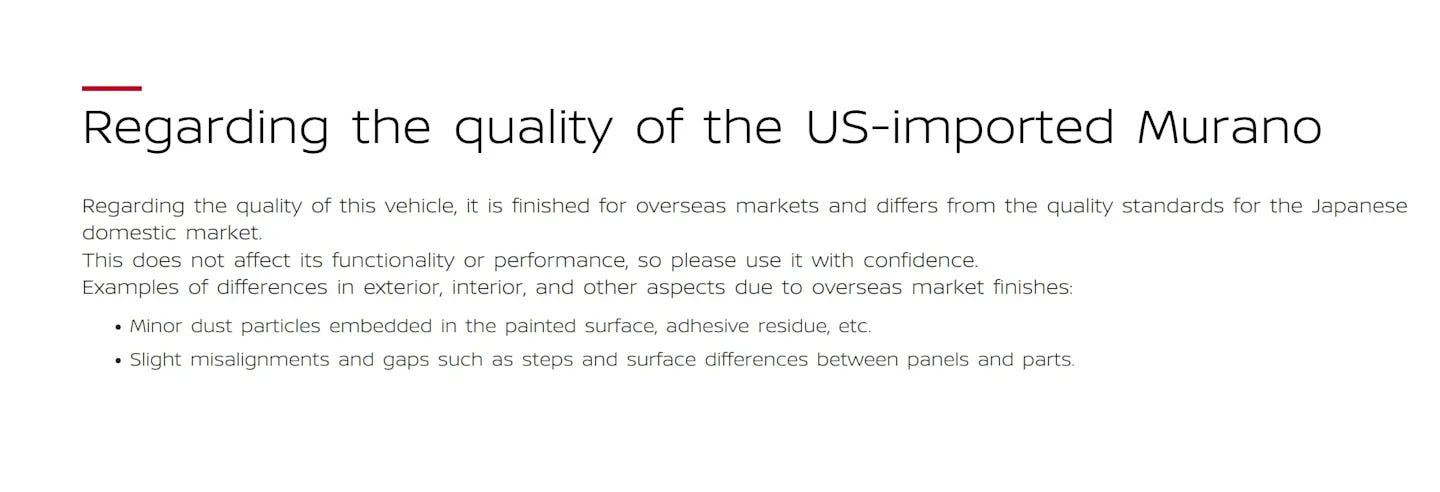
Regarding the quality of this vehicle, it is finished for overseas markets and differs from the quality standards for the Japanese domestic market. This does not affect its functionality or performance, so please use it with confidence. Examples of differences in exterior, interior, and other aspects due to overseas market finishes:
Minor dust particles embedded in the painted surface, adhesive residue, etc.
Slight misalignments and gaps such as steps and surface differences between panels and parts.
The special LHD Muranos, sold to Japan as part of the same complicated and much-vilified Trump trade policies that are bringing RevMax Harley production back to the USA, feature the variable-compression turbo-four instead of the US-market 3.5L V-6. Toyota is making similar disclaimers on its website about Tundras sent from Texas to Japan.
This sort of thing gets Redditors almost as excited as sending their wives out on a Tinder date but there are entirely boring reasons for the disclaimers. The first is simple: most cars built by Japanese automakers are not painted as well at their USA plants as they are in Japanese plants. Sometimes this is for reasons of cost, sometimes it is for reasons of compliance with American environmental laws. When I worked at Honda Marysville we had two separate paint processes: one for Accords and one for Acuras. When we sent Accords to overseas markets, we would inspect and touch them up on a separate compliance line.
If you want to get a sense of how the Japanese like to paint their cars — it’s about USA Acura standard, but not the “PMC” standard seen in various special-edition Acuras that are actually much nicer than JDM Hondas. Can Honda paint an Accord that well? Yes they can, but it reduces the price gap to the equivalent Acura and also not a single one of their customers really cares about whether there are tiny dust spots in the paint. As a former retail auto salesman, I can tell you that raising the price of a sedan by a thousand dollars to improve paint quality is the absolute worst thing any manufacturer could do in any American automotive segment south of “Rolls-Royce Ghost”. Look at how well Acura sells, if you have questions.
America is a big, dirty place filled with unlicensed drivers and gravel trucks being driven in the left lane and acid rain and Bunker C used to fix Michigan freeways and the list goes on. There’s no percentage in fancy-painting mass-market vehicles. This is doubly the case given how much more affordable an Accord or Murano is to an American consumer. Privately owned cars are a much bigger hassle in Japan than they are here, and it takes a lot more money to own them. If you paid the total cost of an Accord in Japan, you would want to have flawless paint, the same way no one wants to see a horsefly bite in a Birkin bag.
The second reason for the warning is cultural: it shields the automakers from being beaten up in Japanese court over minor flaws in the car. This will come as a surprise to Americans, who have become sadly accustomed to a court system that hates them and will endure any hardship in order to privilege a foreigner over them, but the average Japanese court is interested in the greatness of Japan and is therefore not favorably inclined to something like an imported SUV. So if a Tennessee Murano has issues, there is a real risk of the courts slapping Nissan with the same malice an American company could expect if they poured industrial byproducts into the Beverly Hills water supply or used an intact white family in a television commercial.
I can’t speak for Nissan, but Honda operates a global mother plant in Ohio. It is certified to make any thing that Honda knows how to make, to any standard of excellence that Honda knows how to achieve. The NSX was built in Ohio. Go look at the paint on the NSX. My point: If you think this reflects some sort of “lazy American” business, you are flat wrong.
On the other hand, if you were to inquire about the remarkable number of young people being caught having sex inside the Anna Engine Plant, that would be a completely reasonable American stereotype that proves true in real life, and on befalf of Ohio I would like to accept our ribbons of shame.
What a "sign of the times", this loser dumps a trash can out on the sidewalk so she can steal it, but gets fired from her "exec" job as Executive Director of Community and Industry Engagement for Card and Connected Commerce at JPMorgan Chase. https://nypost.com/2026/06/23/business/woman-who-emptied-knicks-trashcan-on-street-then-stole-it-was-dei-exec-worked-at-jpmorgan-chase/
There is an inverse correlation between length of corporate title and job value.
So Jonny running dead last is about as probable as Mr. Burns failing to take candy from a baby... 😅