

Everyone, say hello to our friend Shortest Circuit and his review of a watch that will be (unfairly) unfamiliar to almost everyone! — jb
The name Sébastien Chaulmontet may not ring any bells, but if you have a watch with a SW300 movement, you already own something bearing his touch. The wiry guy in thick-rimmed glasses walking up to my table at a Zürich café looks more like a lawyer than a passionate watch collector and marketing director of Sellita1. In his spare time he collects mostly Angelus and Longines timepieces, but he’s interested in odd complications, or prototypes that never made the market. He also holds 4 patents related to the venerable Valjoux/ETA 7750 movement; while working on those, he had this idea of creating “Imaginary Vintage” watches that aren’t simple reissues of old designs, instead something that could have been purpose-made in the 40s or 50s. From his home office he can see the Albis mountain range, with its highest elevation being... the Albishorn. That’s the company name taken care of, then.
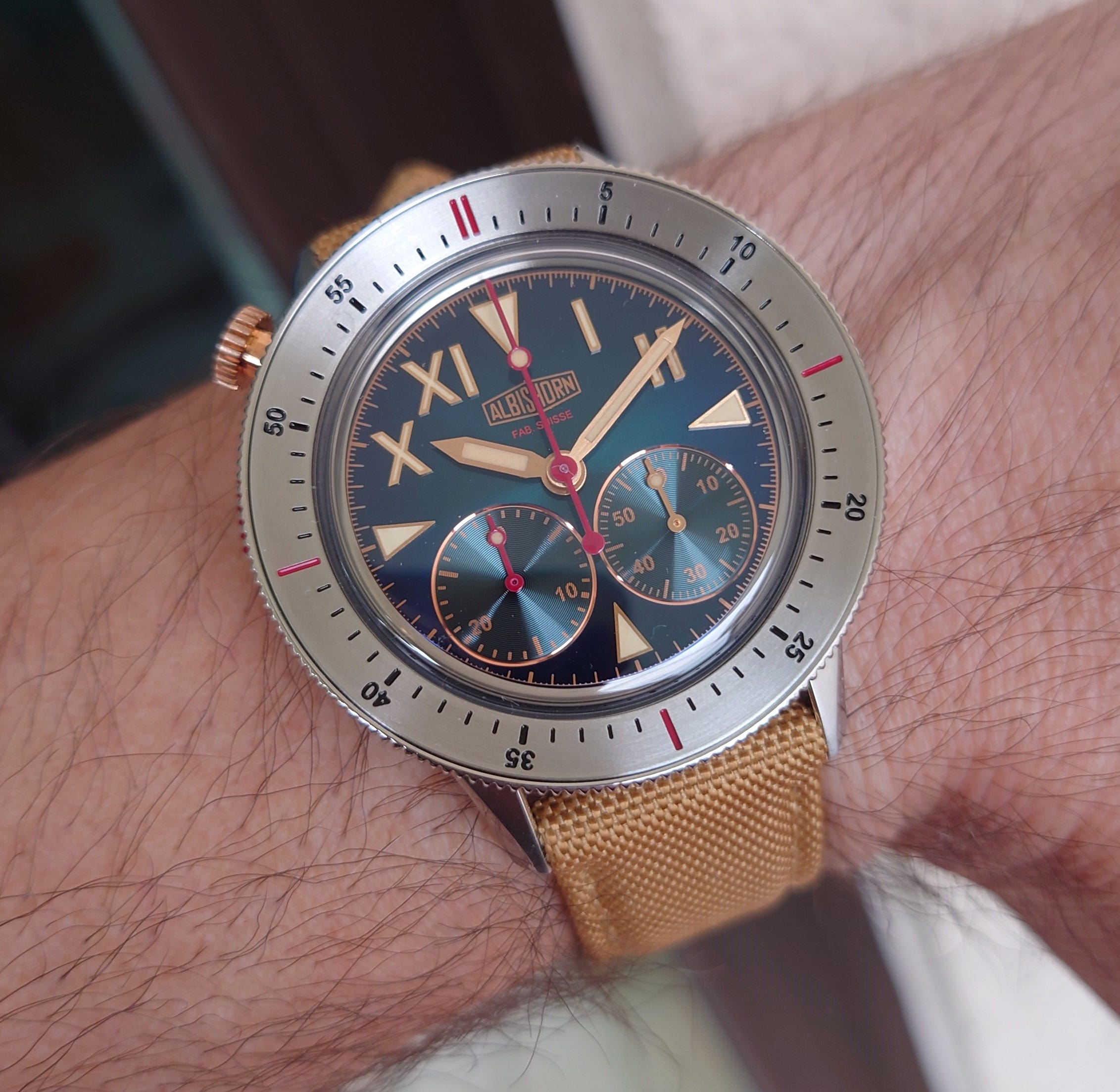
Looking at the watch on my wrist, all of this tracks. The case design heavily references the elusive Rolex Zerograph flyback chronographs, and the watch face is a mix between a Breguet Type XX and a 1944 Rolex-Panerai that Albishorn calls “California Ghost”. Looking at the arrangement one would be tempted to think of some heavy modification to the base 7750 movement, but if you note that the crown is nestling in the unusual 10:30 position, you realize that the minute counter and the running seconds are in the standard 9 and 12h positions, just rotated through 125° so that they are inline at the bottom. Sébastien explains: “We did a lot of work to shrink it down to from 7.9 to 5.7mm - you don’t lose thickness just by omitting the 12h counter. This is why it’s not automatic. But we increased the power reserve from 48 to 65 hours!” I must have furled my brow because he assured me that despite the patented monopusher complication, any watchmaker familiar with the base movement should be able to service it. Albishorn sells the watches with a 2-year limited warranty, and they will ship the bespoke parts2 to anywhere in the world. There’s not much sense in sending it back to Switzerland from the USA for a simple ‘clean and oil’ service anyway.
So what is the story of this one? It was inspired by the 1952 Swiss expeditions to Mount Everest - the primary objectives of which included exploring access to the South Col, conquering the intricate Khumbu Icefall, and potentially advancing to the South Col. They came very close; mountaineer Raymond Lambert and sherpa Tenzing Norgay had set a new altitude record of 8,595 metres when they faced the impossible choice of summit (and die) or retreat (and, perhaps, try again). Following this near-success in the spring, they resolved to make another attempt after the summer monsoon. However, they didn’t settle the schedule until June so the second team arrived too late, facing harsh winter conditions, and was forced to abort. The following year, New Zealand climber Edmund Hillary and Sherpa Tenzing Norgay used the experiences gained by the Swiss teams (and some of the provisions they left behind) to make a successful summit push. The Swiss would have to wait 4 more years to plant their own flag on the mountain.

Pictures of the 1952 expedition are extremely rare but if you look at the Brits’ photos from the following year, you’ll notice cylindrical containers with an intricate logo of a Swiss cross and rope on them - this is engraved on the caseback. That logo belongs to the Zürich-based “La Fondation Suisse pour la Recherche Alpine”, the Swiss Foundation for Alpine Research. Since 1939, they had organized expeditions to the Himalaya and this was their logo. Until José Perez (of Perezcope fame) pieced together the story, nobody had any idea how Rolex Daytonas from the 70s came to existence with this “mystery cross” on their casebacks. The most credible theory is that the Foundation ordered them for the 20th anniversary of the successful expedition.
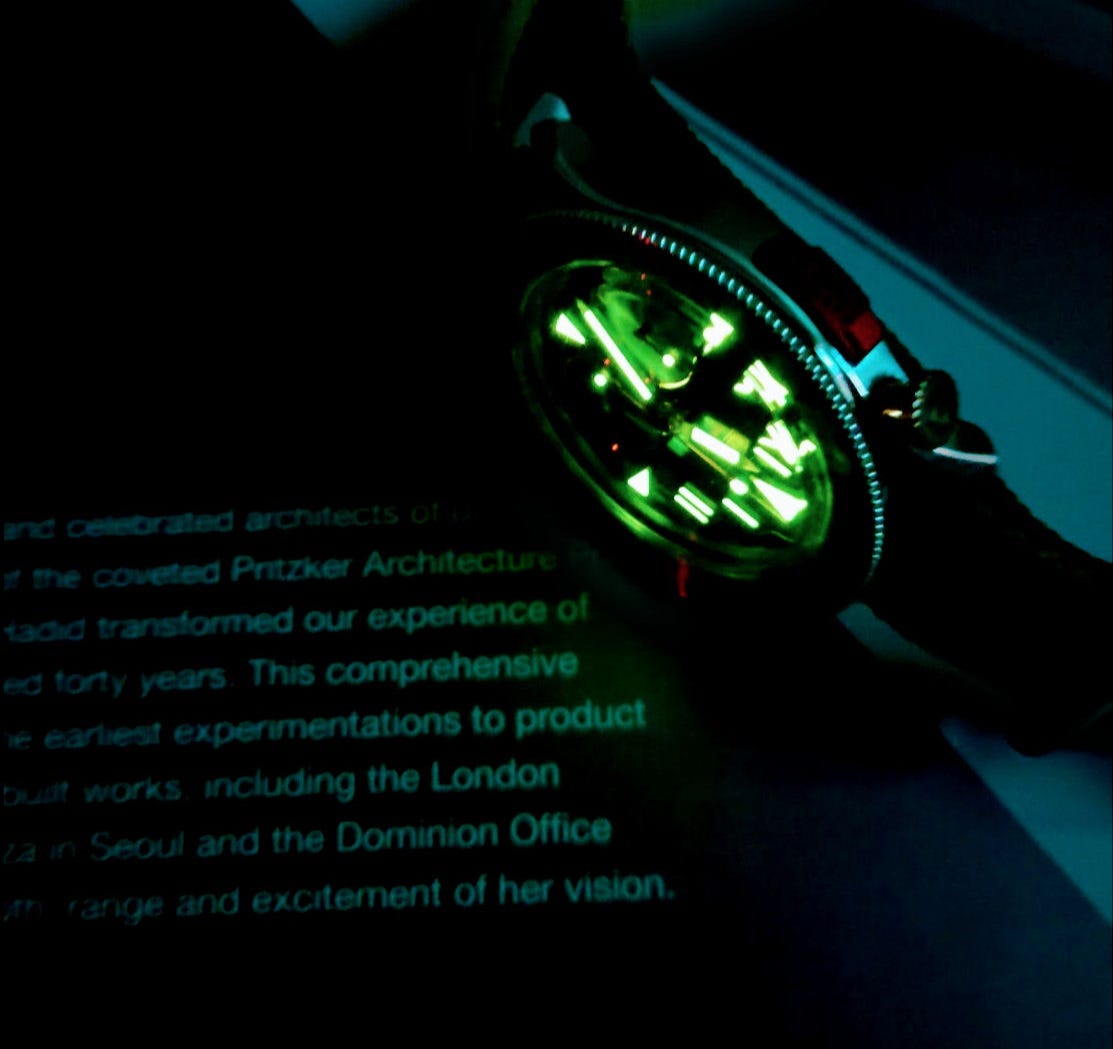
Not a bad starting point for a homage then, 70 years on. The Thundergraph’s iridescent petroleum-blue dial is intricately detailed; as I turn it into the sun to appreciate the color, Sébastien explains that he uses a dial maker in Neuchâtel who gold-plates the polished brass base, then applies one coat of blue, then diamond cuts the subdial edges, gold plates it AGAIN so the angles are shiny, then applies coats of clear lacquer that create depth. A loupe or a microscope is necessary to see that the gold finish on the applied indexes and hands is brushed - and they have beige Super-Luminova filling. The subdial hands also have a luminous lollipop at their tips. It is a lume monster as I find out later that evening. The subdials have an azurage finish, this creates the optical illusion of concentric circles but it is actually a spiral with a beginning and an end.
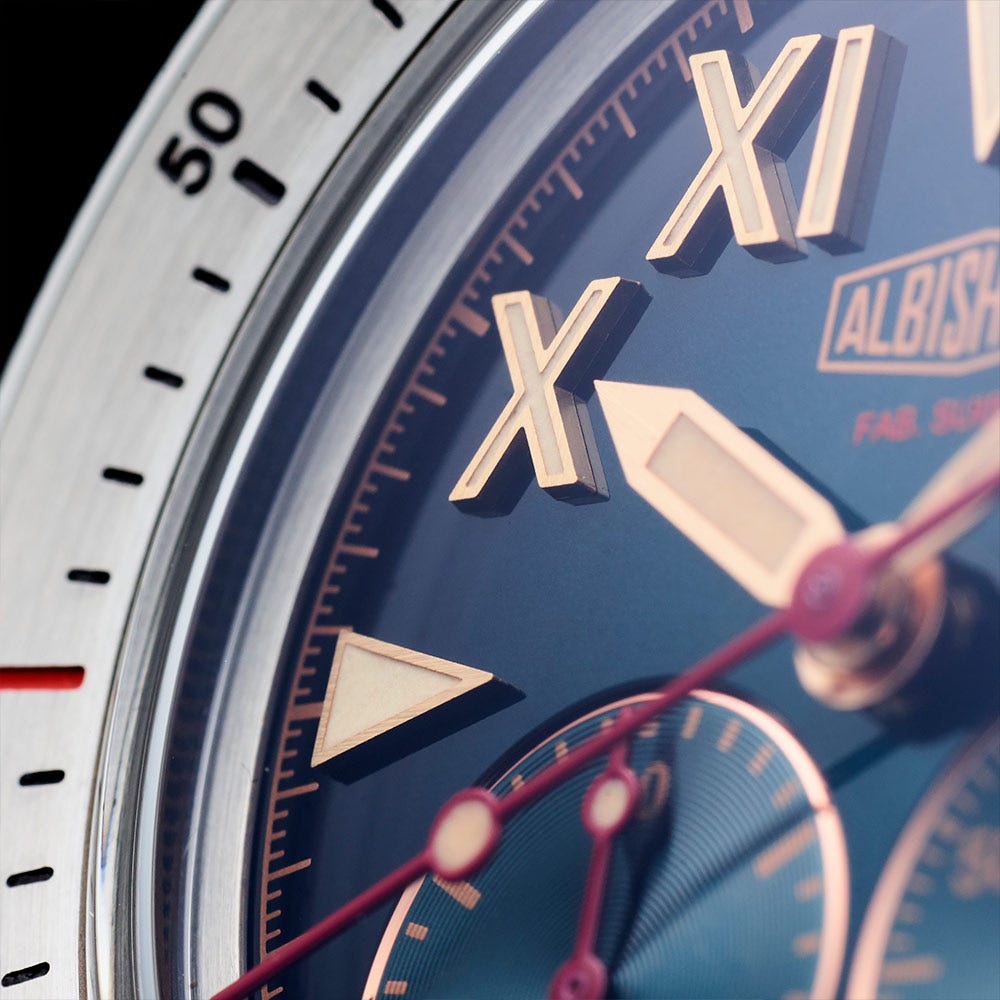
Despite the expedition-ready looks, it wears like an everyday watch. Case diameter is 39mm across with a 42.5mm bidirectional bezel, and thanks to all that mechanical development, it is only 12mm thick. From the manufacturer it comes on a nice petrol-blue leather strap (a tan suede strap is included in the box) and there’s an option for a bespoke steel link bracelet. As I keep finding out, it can live very nicely on an olive NATO or a yellow sailcloth strap as well. The blue strap complements the dial, while the yellow or tan ones complement the crown. We talk with Sébastien for some time about the chronograph pushers, his point is that mechanically they should be made with the least resistance, just to be easy on the parts that have to slide on each other; I chide my Tudor’s MT5813 a bit, which feels like you’re breaking a hamster’s ribs every time you start it. (Try an IWC Doppelchrono sometime, it’s worse, and the Piguet Omega Broad Arrow was worst of all! — jb) The Thundergraph Himalaya is better by contrast, starting and stopping feel the same, with a definite take-up point. The 3rd push (the reset, which has the most subassemblies to actuate) feels the stiffest, but still not as rough as the Tudor.
So you get:
a story
a 100% Swiss designed and made, COSC-certified chronometer with hacking seconds, two straps, 330ft/10bar waterproofing
a soft travel case in a presentation box.
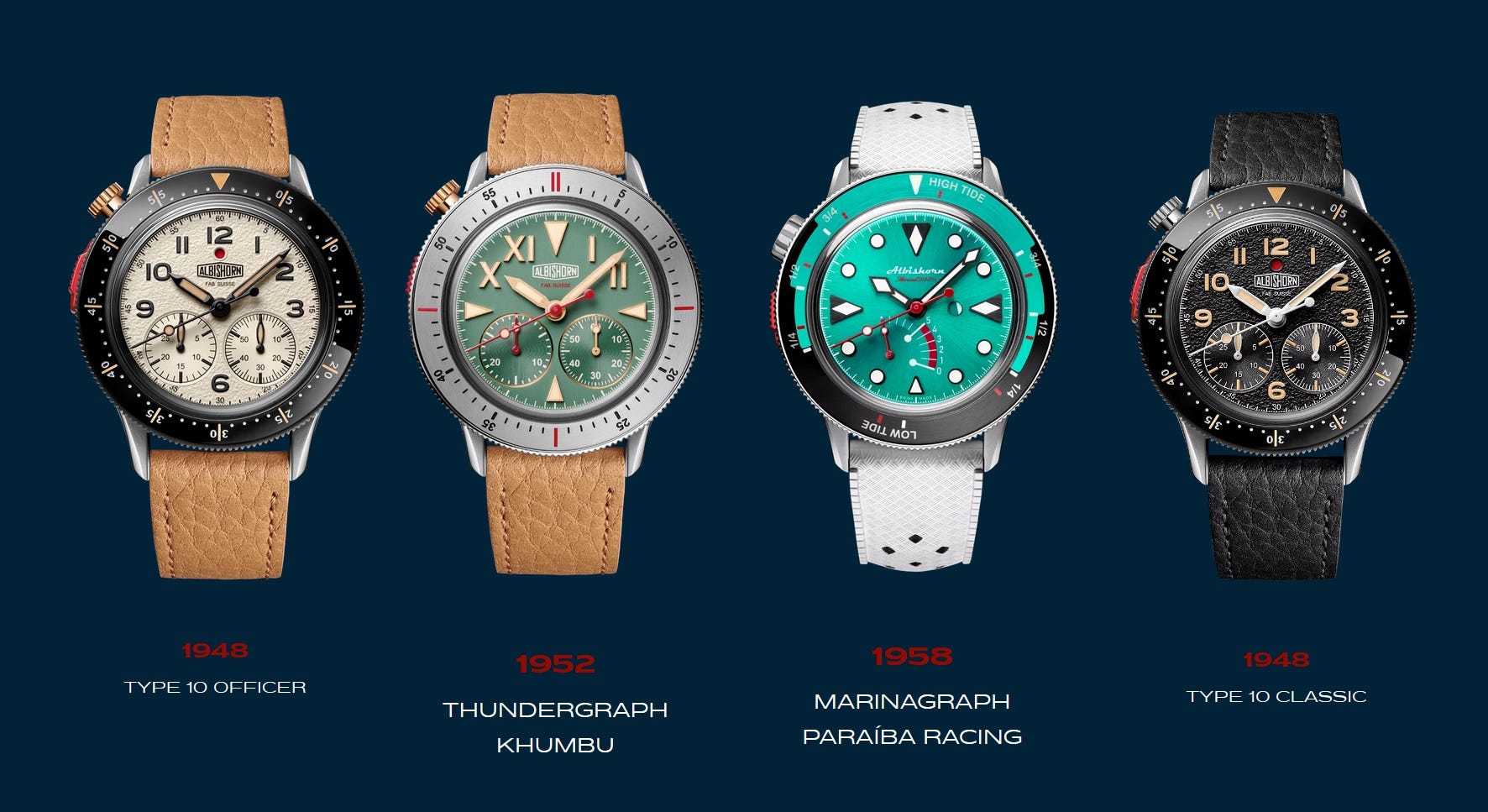
The watch is CHF3,650 (ex. VAT), if you’re the traveler type, I’d recommend picking it up in person, or at least in Switzerland, so you only pay the 8% tax on it. I think you get exceptional value for your money. Albishorn has other watches as well; the sister model to the Thundergraph is called the Khumbu, it is light apple green, matched to a vintage Land Rover Defender color. Their “Air” line has one novel complication - a chronograph “telltale” like fighter plane instrument clocks had - it shows black if the chrono is reset to zero, red when running, and white when stopped. The reason for this is that in high G-load situations you want to be darned sure that it was you who started the clock, not an errant shock. The newest of their offerings are the “Water” line of watches that are a combination skin diver/regatta timer - with another patented complication that stops the regatta timer at the end of the 10 minute countdown. You’ll pay an extra CHF300 for the Air and Water watches because on those even the bezel gets luminous indexes.
Sébastien Chaulmontet might not be a household name, but if you enjoy Swiss watches, his should be a name in your household. This watch might do well there, too.
He was also a lawyer in a previous life.
It's mostly the standard wheels with shortened pivots to fit the thinner bridges.

Wow. Thanks for this.
Lot of value there for a bespoke Swiss timepiece.
Nice. Thanks for the well written detailed review.
I kind of like the Type 10 Officer version. But $5k USD, nope. I’m way too cheap and VERY hard on watches.