

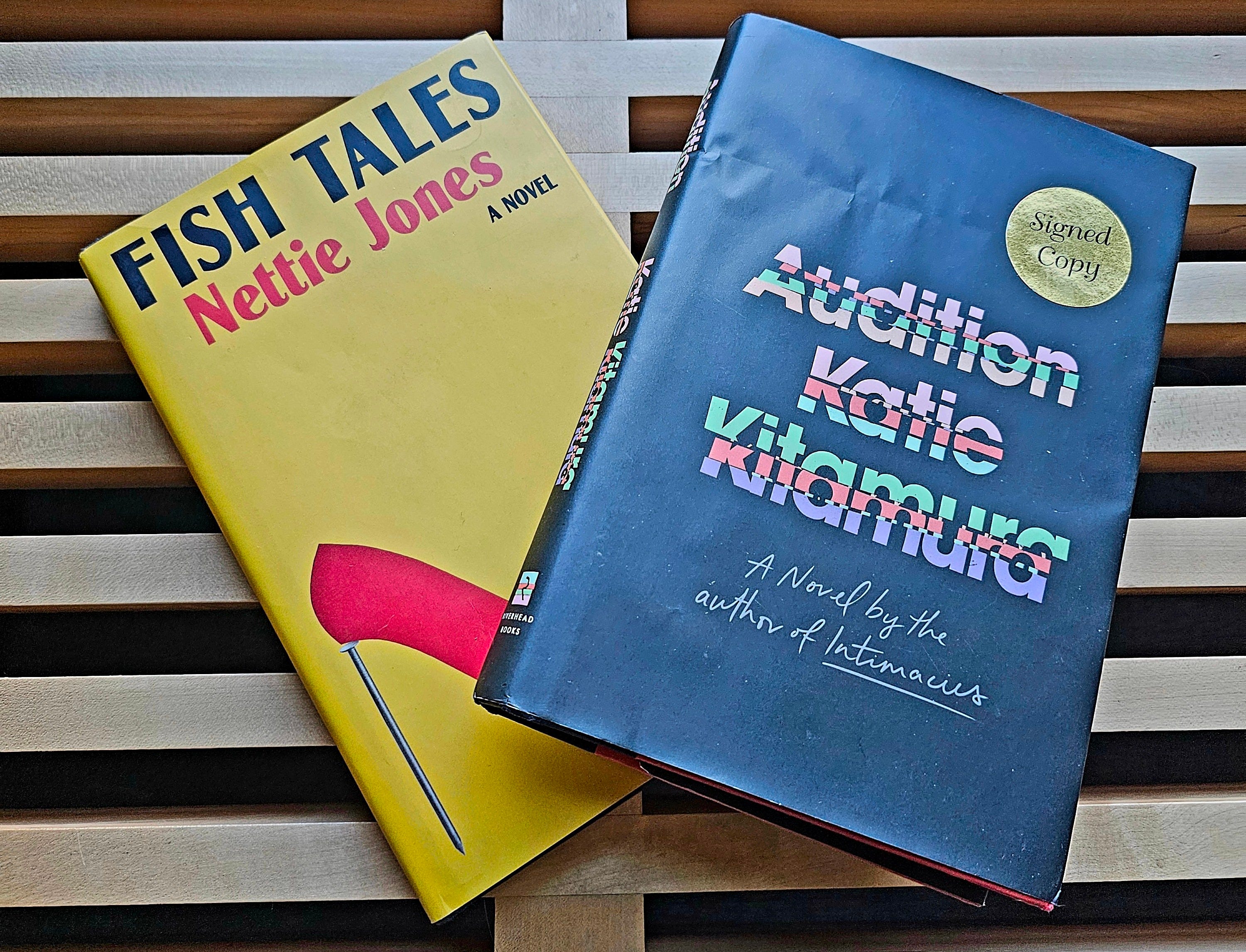
I’m going to restart the ACF Book Club for July. As before, it is for paid subscribers only. If you have a suggestion for a book, leave it in the comments.
In the meantime, we have two reviews of novels with… well, not a common theme, but a common existence. We will start with the astoundingly dirty one, of course.
Fish Tales, Nettie Jones, 1984 (and 2025). Those of you who have read Cat Tales, my recent nonfiction book which, unlike Nettie Jones’s Fish Tales, is not about bisexual perversion in Detroit, will perhaps recall that I briefly digress in one of the stories to talk about how much I dislike the work of Toni Morrison. You can argue that perhaps a friendly little anthology about feral cats is not the ideal platform from which to throw stones at that particular idiot, but you go to war with the platform you have, not the platform you want.
Scratch that. Toni Morrison is far from an idiot. She is a smart and successful human being. She is simply not a gifted writer. Like Brick Top’s associate in “Snatch”, who has all the characteristics of a dog except loyalty, Toni Morrison has all the characteristics of a gifted writer except the gift. Her educational background was HBCU/Ivy picture-perfect, she went directly from being an English student to being an English teacher, she was an editor at Random House before she got her own first book off the ground, and she has won every useless literary award with which it is possible to festoon a nonentity in the manner of North Korean generals clinking and rustling past a review pavilion.
Although I despise Morrison’s novels, I had always assumed that she was at least useful at her day job as an editor — until, that is, I read Fish Tales. This book had been turned down elsewhere before Morrison bought it, which is no stain on its virtue; both Moby-Dick and Dune were rejected dozens of times before someone took a chance on them. In fact, I think Morrison’s decision to purchase Fish Tales speaks well of her. Even if 95% of her thumbs-up came because she was a Black woman who mostly wanted to hire other Black women, the other 5% is admirable. Kind of like how people gripe about the Waffen-SS but are just blown away by the uniforms.
My issue with Morrison’s Fish Tales connection is this: Nettie Jones wrote a book that was one competent editor away from being worthwhile, and she didn’t get one. This was a betrayal of sorts. Morrison took the ball from Jones but couldn’t carry it over the line. In a conversation with the NYT, we learn that
Looking back, Jones still feels stung by how little editorial attention and promotion she received.
“I just don’t think I was what she expected, and that was because I had no fear of her — I didn’t know I should’ve,” Jones said of Morrison, then laughed. “I wish I had kissed her hand, if that’s what it took.”
Zero surprise. Her editor was a woman who never really managed to finish a book correctly on her own, and who has been endlessly praised for accomplishing very little. Oh well. Fish Tales was panned on its debut and fell into a well-deserved obscurity during which its author nonetheless continued to live a life of astounding privilege in various undeserved professorships and fellowships that she nevertheless managed up to screw up to the point that, according to the Times, she was reduced to living in a homeless shelter. At one point she even quit a job at NYU, which is an act of astounding self-sabotage even your humble reviewer is unable match. She is now 84 years old and living in a “subsidized” Brooklyn apartment.
Fish Tales has been reanimated for 2025, in hardcover no less, by (no relation) Hagfish, a publisher that specializes in reanimating overlooked or discarded titles. It’s been feted in a few major review publications as a work of unrecognized genius, so I wasted no time in ordering a copy.
The story of Fish Tales is fairly straightforward: during the 1970s Lewis, a (never directly stated, but implied) Black woman in the Detroit area leaves a long-term sexual relationship with her middle-school teacher to marry a successful dentist who is a “freak” in his spare time. He first permits her to have sex with other men, then encourages it, then joins the party himself. Lewis becomes part of a freak subculture presided over by two flamboyant male sex workers, zipping back and forth between Detroit and Greenwich Village as the never-ending party dictates. After being hospitalized for self-harm she falls in love with a six-foot-five (implied) white paraplegic doctor and devotes herself to his care, which brings her into conflict with his other girlfriends, and things get violent again.
The end.
I was massively disappointed after the fact to find out that the book was about ninety percent autobiographical, because I thought the idea of a black “freak” chick falling in love with a giant white cripple who is somehow the abuser in the relationship was admirably innovative. Turns out it actually happened to Ms. Jones, along with pretty much everything else in Fish Tales. Truth really is stranger than fiction.
If the universities had any sense, they’d replace whatever Toni Morrison junk they currently force down the throats of their students with this book. Not because it’s great, or literary, but because it would remove their generation’s illusions about having invented anything sexual. The freak scene of the Seventies was, as we would say in tech, feature complete for kink. At least the physical aspects of it. You have all the possible combinations of Plug A and Slots B/C/D going on, plus exhibitionism, plus groups, and so on. The freaks, of course, were not inventors themselves, at least not in terms of who did what to whom; that’s all as old as classical antiquity or longer. They did, however, kind of amp everything up courtesy of a laundry list of drugs that had never been simultaneously available to any of their predecessors.
Jones details all this in prose that is rarely explicit even when it is obscene. She also does a half-decent job of capturing something that most of us are or were better off not knowing, to wit: the combination of powerful drugs and uninhibited sex play is addictive in a way that reaches into the marrow of one’s bones. Once experienced and understood, it is impossible to forget or dismiss. Her collection of “freaks” is vastly diverse but united by one thing, namely that they can’t give up the game. For Lewis, Ms. Jones’s stand-in, there is only one desire stronger than the freak flag. That desire is to be needed. Enter “Brooks”, the handsome doctor with a knack for breaking women’s souls in half. What he has to offer is stronger than any combination of plugs and slots and pills and puff. He offers her a purpose.
The concept of Fish Tales is both acceptably strong and usefully shocking. If it is autobiographical, then so be it; that’s the most common characteristic of first novels. Rather, it’s the execution that fails. This is one of those books that suffers from what I think of as “blocking issues”, with “blocking” having the meaning that it does in theater. Ms. Jones knows what the characters are doing, and why. She just forgets to make it plain, or even visible, to the reader. There is too much obscurity, too much random movement of place and person. A little bit of obscurity can be artistic — and hold on to that thought, we will return to it — but too much is merely inept. It takes no great skill to scribble nonsense and expect your reader to imbue the required meaning. That’s how you get the “poetry” of Rupi Kaur or Maya Angelou.
In another life, Nettie Jones could have been a great author. She drives Fish Tales to a workmanlike conclusion and leaves no thread uncapped, which is not something you could say for many modern writers. Her misfortune was to meet Toni Morrison, who was busy polishing her own lamp and therefore had no time, or no skill, to be a worthwhile editor.
Let’s call it, “a great idea, inadequately realized”, give it a Grade: B-, and turn to:
Audition, Katie Kitamura, 2025. Rarely have I read a book that is so alternately exhilarating and infuriating. Mrs. Kitamura, a tolerably lovely Japanese-American woman married to race hustler, third-rate Pakistani-British slopwriter, and fellow NYU professor Hari Kunzru, has a knack for patiently assembling beautiful phrases from commonplace constituent parts. Much like Lisa Taddeo, the author of the (mostly) nonfiction Three Women, Kitamura just plugs along doing nothing in particular until somehow she arrives at a little Faberge egg of sorts. In the below scene, the narrator of Audition recalls a time when she had been briefly pregnant before miscarrying and she had surreptitiously caught her husband using an awful white-trashy app that tracked the size and development of the fetus she wasn’t yet sure she wanted to keep:
I recalled the way he had been, in those brief weeks, more than usually attached to his phone, there had been an almost tender intensity to the way he had consulted the device, so different from the usual irritation and worry with which he would scroll through the news or his messages. I realized that he had fallen into the cotton-candy world of the app, the soft corners of its feeling, he was using the app not despite its aesthetic but because of it.
This writing would elicit nothing but a snort from someone who is accustomed to the Coltrane-esque sheets of sophistication blaring from the horn of an Updike or Pynchon, but through the one hundred and ninety-seven pages of Audition I came to enjoy handling Kitamura’s phrases in my mind the way one might unconsciously over-caress a perfectly joined and fitted wooden cigar box. Her facile wordplay is a lesser gift, like the durable sheen of studio production applied by Christian Karlsson and Pontus Winnberg to a hundred Britney-Spears-or-similar tunes, but it is a gift nonetheless and to see it exercised to such an extent is almost indecently enjoyable. She has taken the delight of reading an upscale fiction journal in one of the better airport lounges and simply mass-produced it to novel size. If Fish Tales means to continually shock you with the language and the sentiment, Audition condescends to soothe with those same tools.
Which is probably why the novel, as a whole, is such a stupid bummer. Here’s the plot: A actress of a certain age and an uncertain race — somewhat like Nettie Jones, Kitamura defiantly refuses to describe most of her characters in this respect other than to say that they are of an “underrepresented” race, which in a more amusing world would mean Inuit or Martian but here is 100% likely to be Japanese-American, because for her to imagine anything else would be a purity-circle misstep — gives an interview in which she discusses having had an abortion. The article, when it is printed, obscures this choice into “giving up a child”. Cue the arrival of an engaging young man who believes, or claims to believe, that he is her abandoned son.
It would greatly surprise me if Mrs. Kitamura had not seen the film “Babygirl” during her completion of this novel; the fake son, Xavier, comes across like a Japanese-American version of the thrusting, manipulative, perfectly self-confident character played by Harris Dickinson in that film. He manipulates and discombobulates the protagonist much like Dickinson does to Nicole Kidman, right down to the sexual aspects; in her second meeting with Xavier, the protagonist is oddly conscious of the various disturbing messages sent by their relative ages and bearing.
Or maybe — let’s face it — both characters are just different faces on the type of man not-so-secretly desired by the boss-bitch crowd.
Audition is split into two parts. In the first part, the protagonist meets Xavier and decides to discourage him in his attempt to enter her life. Then we are immediately shifted to a second universe of sorts in which Xavier lives with the protagonist and her husband, Tomas in their West Village apartment. In this universe, the protagonist is unsettled by the fact that she does not remember much about Xavier’s childhood. When Hana, the dangerous and manipulative girlfriend, moves in with Xavier, the situation degrades rapidly to the point that…
…the protagonist basically sits up and says, “Hey, this has been fun, but I don’t want to pretend anymore,” and at that point we realize that the “second universe” is not an alternate reality at all, but merely a game or fantasy of sorts that she, Tomas, and Xavier had decided to play. And this is where Mrs. Kitamura’s skill becomes insufficient to the task, because the hand-wave is just too big to be covered by delicate little phrasing and pleasurable polishing of everyday speech. In this context, her simplicity of authorial dialect comes off as uncertainty and/or not-entirely-deliberate obscurity. There’s too much fog for the meaning to permeate through in the reader’s direction.
This could have been a much better book in the hands of a more daring author. It fails because it is just so gosh-darn genteel in the modern sense of “NYU-affiliated, self-conscious upper middle class, navel-gazing, angels-on-the-head-of-a-pin, slightly spicy misunderstandings in a co-op or faculty lounge” meaninglessness. It is the work product of someone who has never genuinely suffered and never, ever, will. It reeks of complacency and privilege and affiliation and correctness. The fact that it putatively takes place within a three minutes’ walk of the worst scenes in Fish Tales just drives home the point, because what is New York City now if not a theme park for the self-consciously cosmopolitan cross-racial bugmen, current and aspirational, of the world? And isn’t this Disney-fied self-satisfaction built on the bleeding backs of the freaks and the gays and the union workers and all of the people who experienced a full spectrum of joy, pain, exhilaration, and sorrow in a time when a triple-Photoshop-pixel-smoothing of unimaginable wealth had not yet been slathered onto Grove Street?
You can just feel the bones of Kitamura’s, and Kunzru’s, existence in this book. They have not been short on money or opportunities at any point in their lives. They have effortlessly transited an international web of financial and career support from private schools to foundational grants in order to arrive at their current sinecures. They are a hundred times more loathsome than Marie Antoinette because she didn’t have the cheek to claim that she was a victim of the system or anything other than the princess that she was and that these two authors also so clearly are. NYU invited them here the way the Brits permitted Saxe-Coburgs to insinuate themselves into the rotting corpse of royalty: come here, aliens, and rule over us in your highly deserved glory. We will cover the tab.
So far, so loathsome. Yet this is what I would like to believe: I would like to believe that Katie Kitamura has a brilliant, incisive, transgressive book in her. That she has a secret desire to blow the cover off the various $CITY_reviewofbooks fluffjobs with something awful and painful and striking and unforgettable. That she has chosen instead to write Audition, which is the 70% Lindt dark chocolate of literature1, because she knows that her astoundingly comfortable existence would be rent asunder as a consequence of doing anything different, and she is afraid. I want to believe that she is just one bad decision away from turning her obviously considerable talent towards the sort of greatness that posterity cannot help but concede, like that of Melville. I want to believe that she will live to write that book, and that I will live to read it. But this shit right here? Grade: C+
just in case you’re not a fat piece of shit who eats junk all the time, the 70% is the lowest cocoa percentage bar, and thus the easiest to enjoy; Lindt will cheerfully give you a chance to experience everything up to the fabled 99 percenter if your taste buds permit.
"Jack Reads Modern Fiction So You Don't Have To" -- I've long appreciated this feature.
Honestly, neither of those books sound like anything I'd ever want to subject myself to.
I'm not sure why people want to read books about misery and/or failures of others, I just don't get it.