

Someone in the comments of my Twins piece asked me for a Can-Am review; these are the two that I’ve done.
Can-Am Spyder Review: March 2011, TTAC
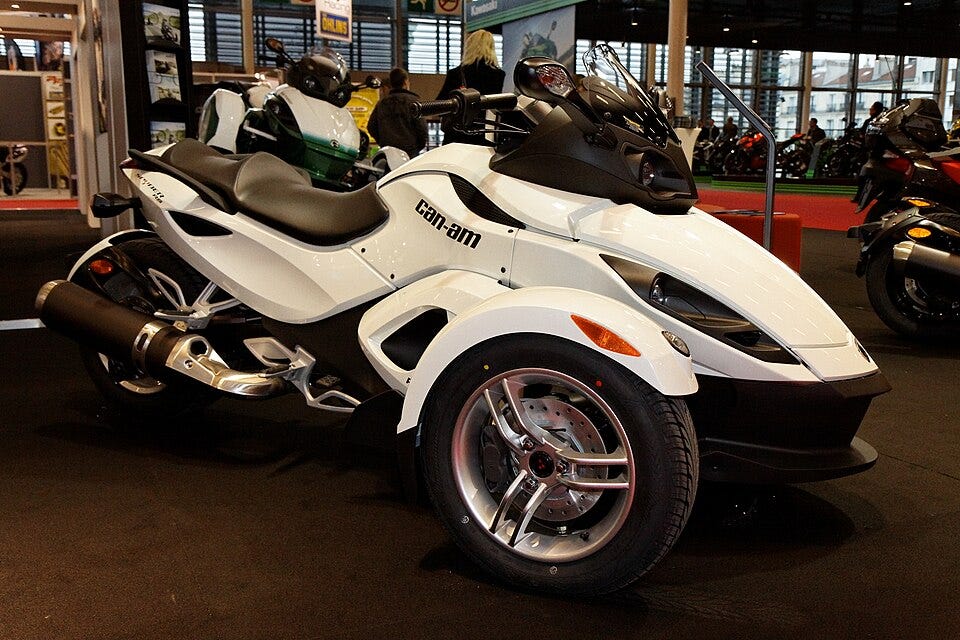
One hundred miles per hour. The once-fabled “ton” which my 1990 Volkswagen Fox struggled to indicate on its outrageously optimistic speedometer is now a commonplace, ho-hum event. Many modern cars will get there in ten or eleven seconds. Even heavy-duty pickups have no trouble pushing their Maximum Overdrive front fascias into the triple digits nowadays — and everything from the Fiesta to the F-450 feels rock-solid at that speed.
The magic, thrill, and terror are all gone from the one after ninety-nine… but if you want to bring it all back, and then some, it’s as close as a trip to your local Can-Am dealer. Driving the Spyder three-wheeler at that speed is, frankly, terrifying.
The Can-Am Spyder isn’t a three-wheeler in the same vein as the renimated Moggie trike, although it also has two wheels in front and one behind. No, this is very much a motorcycle-plus-one instead of a car-minus-one. The rider sits in a position very familiar to BMW touring-bike pilots and operates a motorcycle-style set of controls. If you don’t have some experience on bikes, the Can-Am won’t make any sense to you.
If, on the other hand, you do have some experience on bikes, the Can-Am probably won’t make any sense to you either. I’ve been riding street bikes since 1991 and I was immediately made quite uncomfortable by the way the Can-Am steers. Real motorcycles are steered by pushing down/away on the handlebar end in the direction of one’s intended turn. This causes the bike to fall to that side and to veer, er, steer, that way. The Spyder, on the other hand, is steered by turning the bars towards one’s intended direction.
Once the turn begins, the rider is forced to hang on to the machine by pressing his knees against the seat and pulling on the handlebars. It literally feels like the Can-Am is trying to throw its rider off. It takes an extremely vigorous (and extremely dorky-looking) lean towards the inside of the corner to preserve anything like cornering force. If you’ve ridden a snowmobile, you will be good at riding a Spyder — although the reverse is not true.
There are now several different models from which to choose in the Cam-Am lineup, from stripped-down monocrhomatic sportster to full-dress tourer. Two transmissions are available: a traditional five-speed clutched box or a clutchless five-speed operated by an electronic paddle shift. I took a Spyder rS which had 106 horsepower and the standard transmission to push 699 pounds dry weight. That’s about the same power-to-weight ratio as a base Corvette, and acceleration is similarly rapid…
…or similarly slow, if you’ve been riding modern sportbikes. Not to worry, because you wouldn’t want this vehicle to be any faster. On an open two-lane near the Road America track, I twisted the throttle and hung on for dear life as the Spyder zoomed to nearly 110mph. The front end started to wander — did I mention that each of the 165/65R14 tires at that end are inflated to just 15 psi? Consider it mentioned — and I was yanked back and forth as crosswinds tried to blow the trike out from under me. My motorcycle-trained steering responses were all wrong, actually pointing me towards a ditch. I oscillated helplessly for the approximately one minute I had determined would indicate that I was not an arrant coward before throttling down to a more sensible fifty-five. That’s a law I can live with, at least on this rig.
Oops! Time to make a fast turn. I hung my entire body off the Spyder and prayed. As the inside front wheel lifted off the mother-flicking ground I idly wondered what the effect would be of applying extra throttle, or any brake input, in midcorner. Probably death. That was the last corner I took at any speed much above the suggested limit. I can only imagine what a road like the Tail of the Dragon would be like on a Can-Am Spyder; most likely, it would be the long-non-awaited combination of a particularly vigorous P90X workout, one of the “Fry Guy” spring perches for children at a McDonald’s PlayPlace, and Russian roulette.
The rest of the test drive passed in kind of an odd haze as I wavered between going slower (to save my skin) and going faster (to make it come to an end sooner). Automobile drivers looked at me with open mouths, motorcyclists clucked in pity, and cyclists were ejected, screaming, into ditches as I wobbled left and right across the road. Twenty miles or so later, I was safe and sound in the parking lot, kneeling in what I hoped would look like genuine interest in the brake calipers while I thanked Almighty God for my survival.
I’ve operated a lot of fast machinery, from the Hayabusa and its compatriots to eight-hundred-horsepower Porsche GT2 tuner cars, but nothing has ever made me sit up in sheer terror like the Can-Am Spyder. It’s a true challenge to operate at speed and if you have no children about which you should be worrying I’d recommend giving one a shot. For the fifteen grand or so it would cost to buy one, however, I think most of us would be better served with a Yamaha R1 and some PTSD therapy to forget the test ride.
As a tourer, the Can-am probably works very well. As a sporting machine, it’s mostly notable for the way it delivers thrills at all speeds, even if those speeds are well south of the modest 100-mph mark.
Can-Am Spyder F3-S Review: March 2015, TTAC
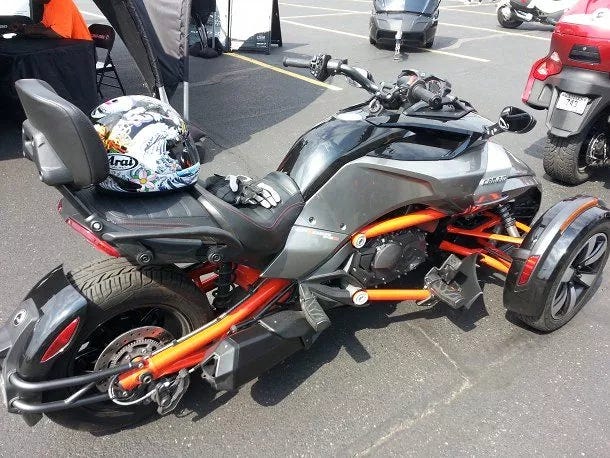
Let the record show that, on the morning that I rode one hundred and seven miles each way to ride the new Cam-Am Spyder F3-S, I nearly dropped my motorcycle.
I’m still not quite sure how it happened. Something like this: I was turning my VFR800 Anniversary Edition around on the slope of my driveway. My left foot slipped on a bit of oil or maybe just water and the whole 539-pound machine fell as my foot continued to slide. About a tenth of a second before it would have been too late, I caught some traction with the outside of my heel and then all I had to do was arrest the slide with my left arm. It felt like deadlifting twice my weight and, for a moment, I thought my thrice-broken left wrist was going to snap again and add a medical bill to the cost of a replacement fairing.
When everything came to a halt and I’d yanked the VFR to vertical, I paused for a moment to consider the following: I’m forty-three years old, I’ve broken eighty-plus bones, and the day that I drop a motorcycle is coming fast. So with that in mind, I clutched in, grabbed first gear, and headed north to meet what I was now quite happy to think of as an un-droppable motorcycle.
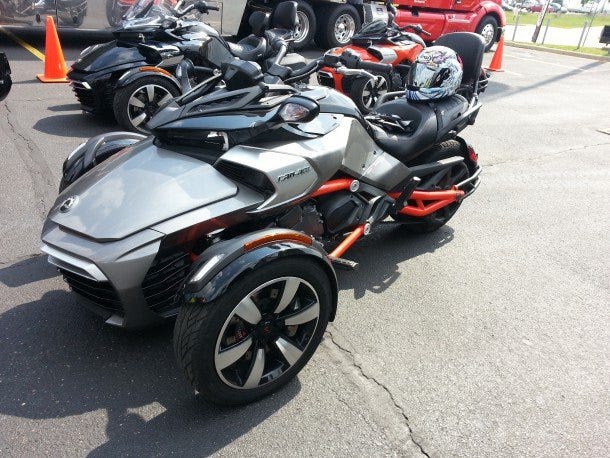
This is my cellphone shot of the F3-S, but because the trike has so many edges and curves, and because there were so many other trikes around, it’s not easy to see what it actually looks like. Let’s use a PR photo, shall we?
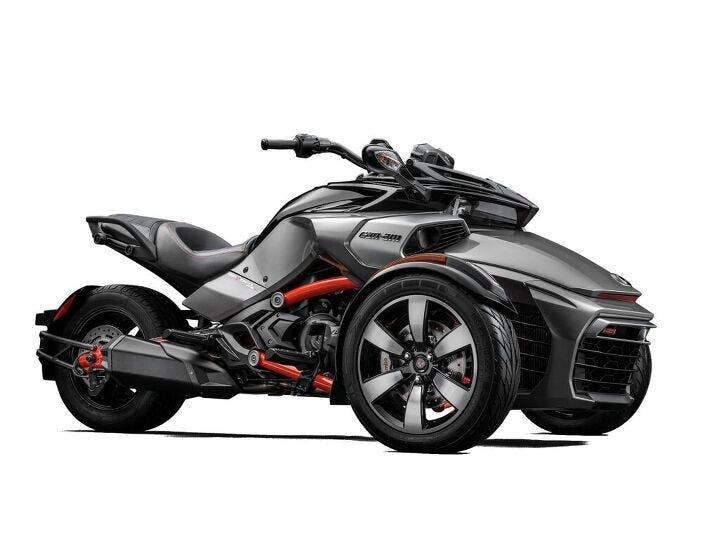
It’s really quite handsome in an odd way and very different from the Spyder RS that I absolutely hated when I rode it a bit over four years ago.
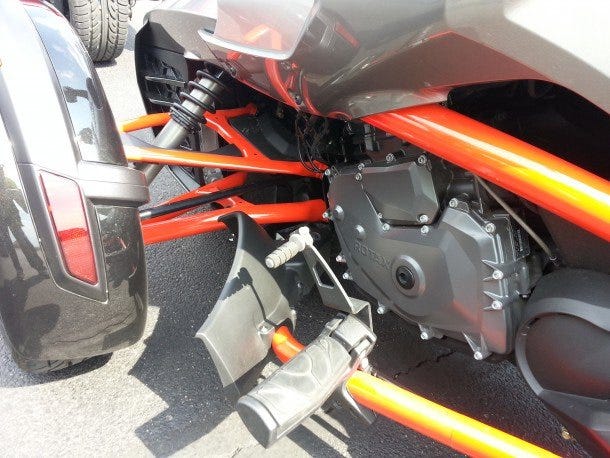
Fox shocks…
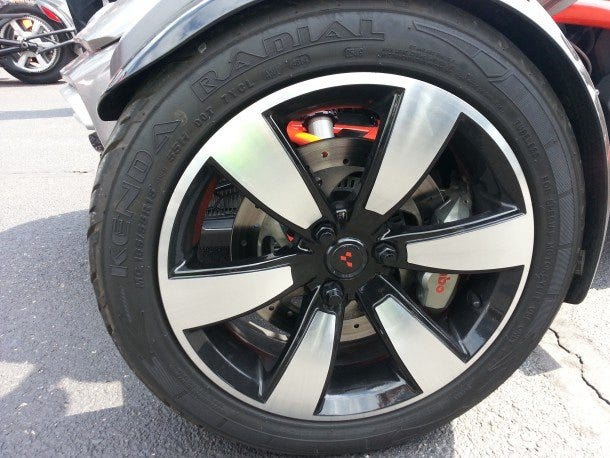
Brembo brakes. What else can you get for $20,999 that has this kind of equipment? Oh, and it had cruise control, apparently. The contrast-color trellis frame has the same appeal here that it has on a Ducati or KTM sportbike. You can see plenty of the engine, which is not the case with the other members of the Spyder family.
To push the Spyder’s 850-pound dry weight, Can-Am offers a Rotax-badged 1330 cc triple capable of putting out 115 horsepower and 96 pound-feet of torque. That’s as much motor as you can get in a Spyder, and it’s the same one that pushes the full-dresser RT tourer now, but we live in an era where most sport-touring motorcycles have over 150 horsepower. Even my conservative old-man VFR has 110 horsepower. So if you’re expecting to keep up with your neighbor’s Beemer K1600GT or Kawaski Concours-14 as they rip to 10.3-second quarter miles, you should walk right past the Spyder and ask for the Yamaha V-Max.
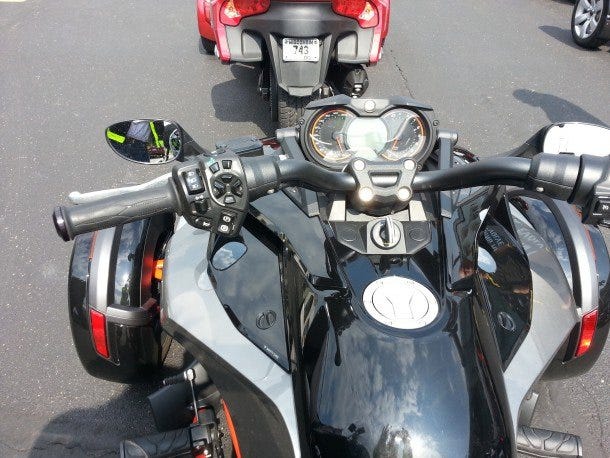
Before I was allowed to ride the Spyder F3-S on public roads, I had to complete a small autocross course with it. Really just an oval with a small chicane down the back straight, intended to be taken at about 15 mph. I negotiated it easily, remembering that the Spyder doesn’t steer like a motorcycle. The fellow who was coaching the novices gave me a solid piece of Can-Am advice I wish I’d gotten back in 2011: “Push the outside end of the handlebars away from you to turn instead of pulling on the inside handlebar.” This also gives you some leverage to get your body moved over to the inside of the turn, which is absolutely necessary if you don’t want to just roll over into a ditch.
Having completed Spyder School without incident, I was then allowed to choose my Spyder. I picked a grey one with the six-speed manual transmission. The majority of Spyders, I am told, are sold with the electronically activated semi-auto. I had no fear of stalling it as I headed down the road for my lead-follow thirty-minute test ride. Only a moron could stall this thing. It’s all torque and no action. I was the second rider of a four-trike group in which both the lead and last rider were Can-Am employees, but the fellow in front wasn’t inclined to take it easy on me and I soon found myself using full throttle to keep up.
The back roads around Lodi, Ohio are rather beautiful. There’s a lake and there’s some elevation change and there are a bunch of great curves and, in short, it’s a completely fucking terrifying place in which to ride a Can-Am Spyder. To begin with, the roads have heavy crown and they’re narrow. On a motorcycle you’d deal with this by riding the centerline unless there was traffic; in a car you’d just deal with it period. But the Spyder wanted to fall into the ditch all the time and my instinctive countersteering motions just helped it in this goal.
With that said, the new seating position provided by the F3 really helps matters compared to the Spyder RS I rode in Atlanta. You’re sitting in the trike, not on it. The footrests are ahead, not under. It’s much like a Harley V-Rod in that way and the footpegs are adjustable to make sure you can stretch out as you like. The lower seat really helps you lean in the turns and, as a result, the F3 never feels quite as ornery as the older Spyders. The swept-back bars are similar to the ones found in the newer touring bikes, and they’re chock-full of controls, including a button that you must press in order to be allowed to start the bike. “Pressing the button signifies that you’ve read the owner’s manual,” I was told.
“I can in no way see that holding up in court, especially since the button is labeled ‘ECO’,” I replied. Nevertheless, you have to do it.
There’s an electric parking brake. But there’s no hand brake lever. Only a big rubber pedal for your right foot. This alone was almost enough to cause me to crash the Spyder no fewer than four times. I don’t use the rear brake foot lever on my motorcycles. Maybe once a ride to clean off the machinery, but that’s it. My VFR has linked brakes, so squeezing the front brake applies the back brake a bit, and my CB550 has a near-totally useless drum back there that I only activate when it’s raining. Time and again I found myself squeezing air when it was time to stop. If you want proof that the Spyder is meant for “cagers”, there you go. No hand brake. How hard would it be to add one as an option? Well, the Can-Am has ABS to go with its ESP, so maybe pretty hard.
My next beef with the trike was this: In a car, you only need to find two smooth lines in a bumpy rural road. On a bike, you only need one. But a trike needs three. If there’s a pothole or a pavement wave out there, a Spyder can find it, and the steering geometry seems ideally suited to following grooves in the road. So I was constantly struggling to keep it going straight on the frost-heaved Ohio two-lane. Now were you to find yourself on a freeway, you’d appreciate the stability of three wheels against wind and fatigue – but ripping down a twisty backroad, it’s miserable.
I also noticed that applying full throttle on said backroads with pavement waves and ripples was quite exciting, causing me to hang off the thing left and right like I was in the original version of Mad Max. Luckily, the F3-S isn’t a Hayabusa and the same amount of twist that gets the VFR to 110 or more only shoves the Spyder to maybe 65-70. If a modern V-6 Camry wants to run you for pink slips, be aware that you’re in what the old hands at the dragstrip call a “driver’s race.”
On the positive side of things, the transmission could not be easier to use. I found myself bumping past neutral into first a lot, but that just speaks to
a) me being a cack-footed moron who rides a 1975 CB550 in traffic
b) the excellence of Can-Am’s synchros.
Less fun is the difficulty I had operating the throttle smoothly while still using the handlebars for leverage. This is where you’re spoiled on a motorcycle because unless you’re in the middle of the Isle of Man TT you really aren’t leaning on the bars very much. I can operate the VFR with fingertips only on the bars at well over 100 mph but you’d be a fool to do something like that on the Spyder. So in left turns I kept over-throttling. This is called “whiskey throttle” by experienced trike riders, apparently. And when you do it, the front end gets light because hey, you’re accelerating HARD. Which reduces the front end’s ability to turn. Scary as hell.
Several times I thought I was going to get the Patrick George Award For Crashing A Vehicle During A Lead-Follow Event, but each time I managed to huck my big ass off the seat in the right direction and calm things down. I got not a single bit better at this during the course of the half hour.
The end of the test ride came not a moment too soon for my personal satisfaction. I respect this machine, but I don’t enjoy riding it and I think it would take me a long time to learn how to operate it safely. “You sure liked that center line,” smirked the Can-Am fellow who was leading the ride.
“Well, being away from it, toward the white line on the side, scared the shit out of me.” He smirked again. I felt like telling him that I’d driven the Zanardi line at Laguna Seca to take first in a race, then realized I didn’t care what he thought of me and neither did he. At that point, I was 100% done with the whole idea of the Spyder.
But as I walked around the Can-Am tent and saw the people who were showing up for the next lead-follow ride, I noticed that most of them were not what I think of as “bikers”. They were older, they were female. More than a few of them didn’t have their “M” endorsement. There were two different African-American couples that were interested in the Spyder RT full-dresser, and they shared with me that they liked the idea of it being stable on the freeway.
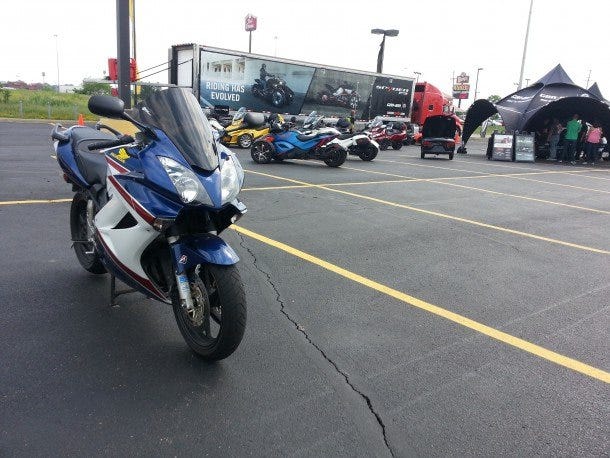
As I got back on my Interceptor 800, which to my immense relief steers in the direction I’m leaning and responds to my wishes without any particular force on my part, I thought about how much longer I could ride something like this. My wrists hurt a bit from the hundred-plus mile ride up and my hands had been a bit numb when I arrived at the demo-ride area. With one more serious joint injury I’ll be done with motorcycling as I know it – or maybe another decade’s worth of arthritis and joint degradation, to say nothing of my right ACL’s refusal to magically reappear, will call time on my riding aspirations. At the age of 23, I could ride my Ninja from dawn till dusk. At 28, I could ride my YZF600R five hundred miles then go for a mountain-bike sprint. Today, at 43 years of age, I can still ride three or four hundred miles in a day if I’m careful. Where will I be when I’m sixty? Confined to my 911 or Boxster or maybe a Corvette droptop? How will I feel about the Can-Am Spyder’s freeway stability and relaxed riding position and relatively modest pace then?
(2026 addition: I’m benching and squatting a lot more than I did in 2015, my joints are more stable, and I expect to ride for another decade. This is entirely because I quit the “sport” of downhill mountain biking.)
On Route 71, heading down a tree-lined section that I’ve long used as a free-fire zone of personal irresponsibility, I leaned over the tank and twisted the Honda’s throttle from my 85 mph cruising pace. One hundred. One ten. One twenty. One thirty. I felt good. As the end of the wooden section approached, complete with a crossover where the Ohio Highway Patrol loves to sit, I crossed into the middle lane and sat up, using my Fieldsheer-clad bulk to airbrake down below go-to-jail speed. Not a problem. I’m not too old to ride this thing, not too frail. Not yet.
But a few miles later, as I alternated the pressure of my weight between my hands to keep the tingles out, I saw a fellow on an old GoldWing conversion trike heading the other way, across the median. He saw me. And he didn’t just do the little nod that bikers do, or the dropped-two-finger cooler-than-thou salute. He actually waved. With his whole arm. It was hopeful, it was friendly, it suggested that we were brothers of a sort, pursuing the idea of being out in the elements and doing our own thing, albeit in different fashion.
I looked up, saw the sun illuminating the white clouds, then I, too, raised my whole hand. And waved. As I will to Spyder drivers, the next time I see one.
Got your own Can-Am experience? Put it in the comments — jb
Jack, I dislike Sherman’s participation in the comments as much as you do but surely there are better ways to scare him off the day before Halloween.
Now we need a review of a Harley Trike through Deal's Gap.