

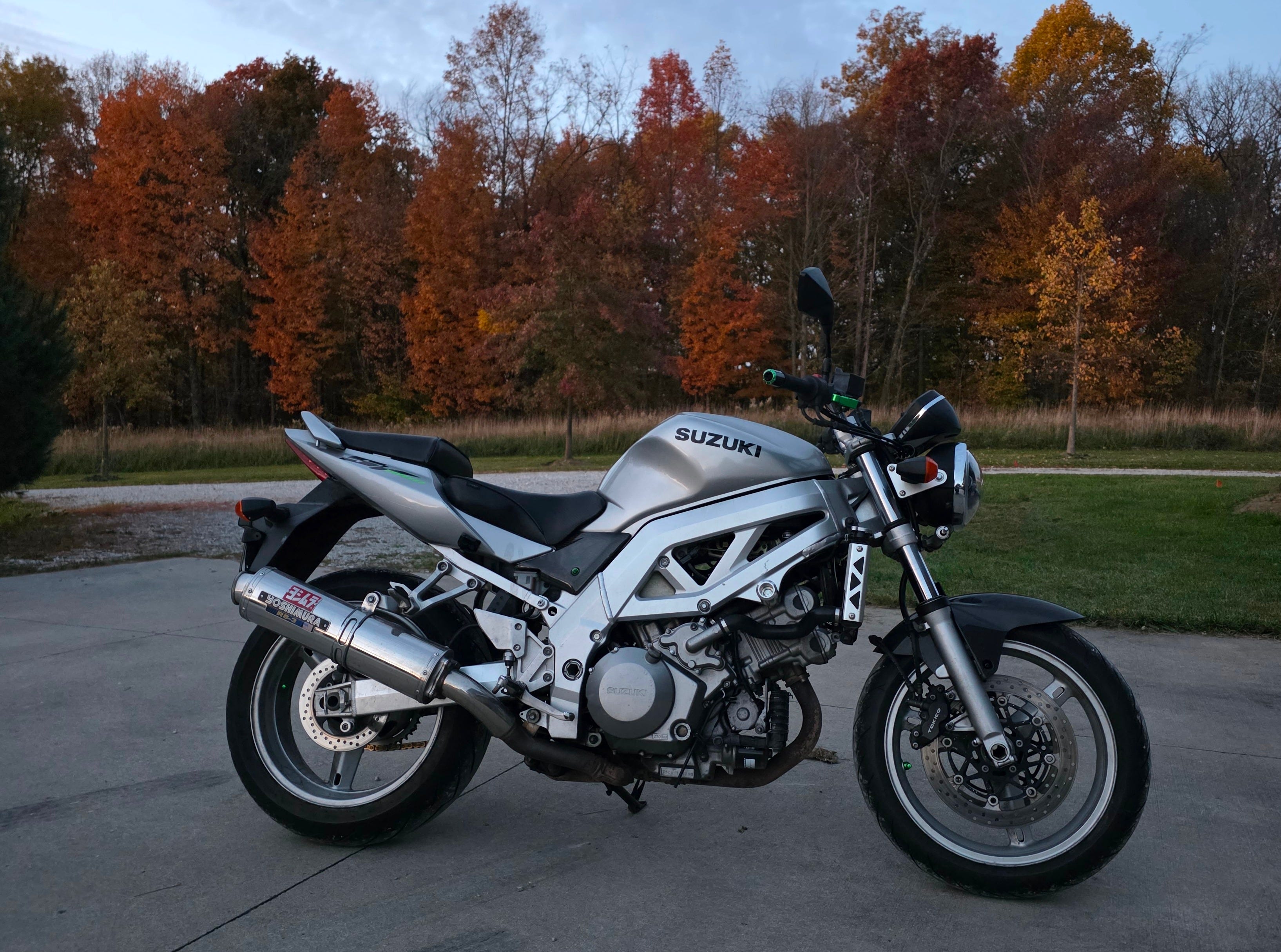
One day you wake up and you’re part of the old guard. I think of myself as a novice motorcyclist, someone who is still learning, still able to improve. While the calendar can’t say anything about my skill as a rider, which is modest, it can certainly remove my illusions about being new to this. I bought my first motorcycle in 1994. It was a 1986 Ninja 600R:
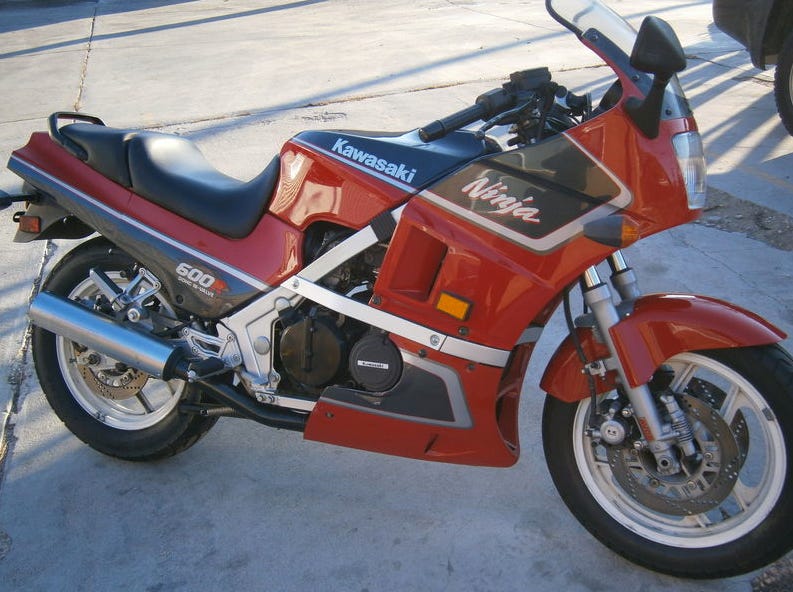
75 horsepower, 135mph top speed (mine wouldn’t budge above 130 indicated), 12.4@108 quarter-mile. This was considered the absolute minimum motorcycle among my local group of riders, who were all in the process of exchanging their dubiously-titled ZX-7Rs for dubiously-titled CBR900RRs. It was assumed in this crowd that I’d bought the 600R solely to have a title via which I could register a stolen ZX-7R; when I just kept riding the thing, one of the Fireblade-mounted brothers at the 7-11 meetup said to me, with a note of concern in his voice, “You’re not a fag, are you? I mean, it’s okay if you are, but…” and he glanced meaningfully at my 592cc motorcycle.
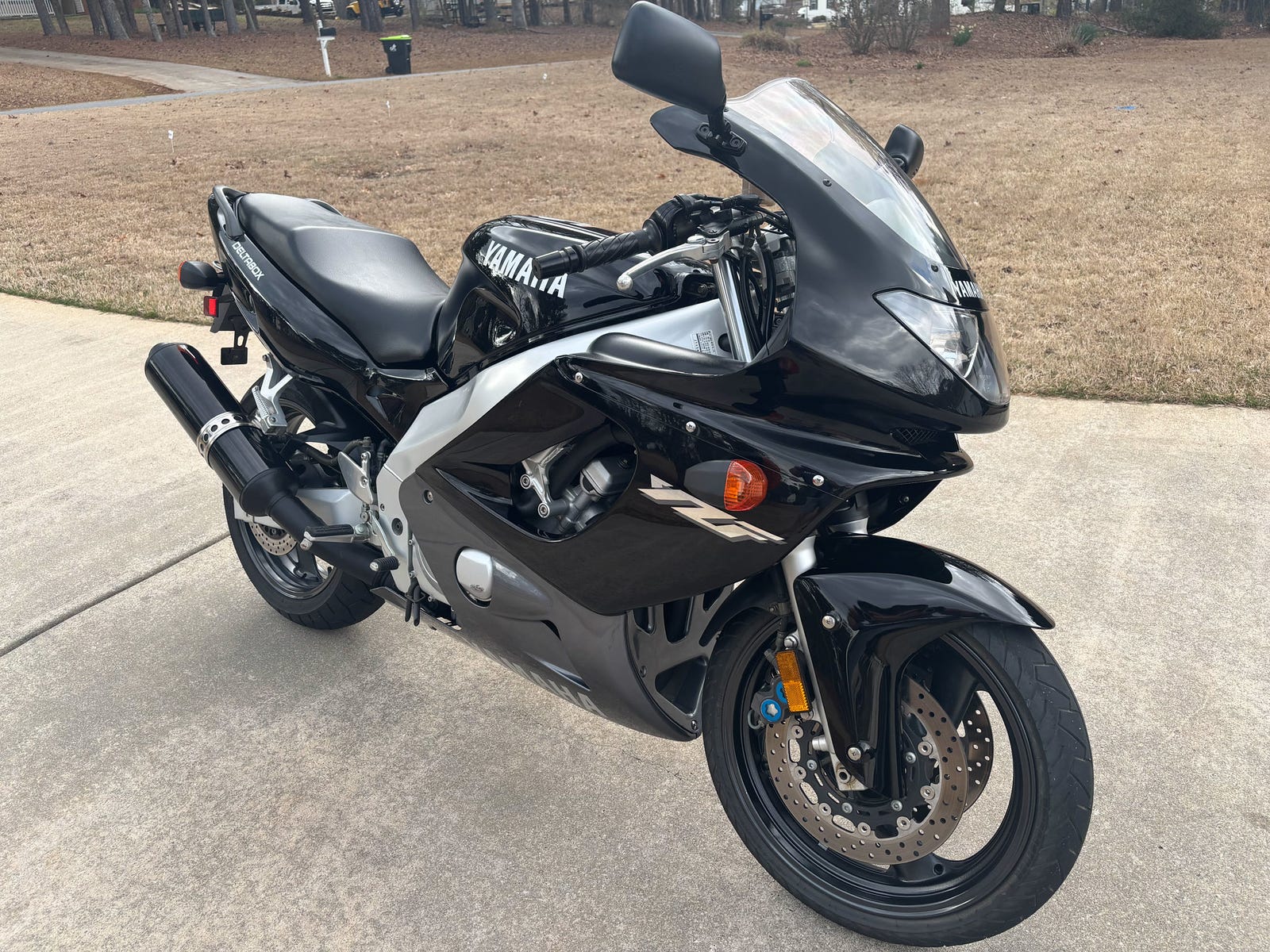
Truthfully, it felt like enough motorcycle for me, as did the 100-horse 2000 YZF600R that I bought new in the showroom a few years later. Eventually, the 7-11 crowd just kind of gave up on me. I couldn’t wheelie for shit at freeway speeds and I insisted on riding homosexual motorcycles. On the other hand, I wasn’t a cop, so I could keep hanging around.
Let me explicitly state that even this reluctant tolerance would not have been extended to me if I’d shown up on anything besides a sportbike powered by an inline-four. Like everyone else in the Midwest, our group took its cues from the Starboyz up in Akron, a mixed-race group of angry young men who glued fur to their fairings and whose VHS videos depicted a lurid combination of freeway stunts and defiant thumbs-ups issued from the intensive care unit of the Cleveland Clinic. The Starboyz, and everyone else, did not ride any motorcycle that couldn’t explicitly trace its conceptual lineage to the 1984 Kawasaki Ninja 900. That meant: water-cooled inline-four in a perimeter (later, twin-spar) frame, displacement of 750cc or above, at least 115 horsepower, miserable riding position.
Naturally, we were aware that other motorcycles existed. Harleys, Ducatis, Beemers, Gold Wings, Moto Guzzis, metric cruisers, oddball stuff for swingers or meth dealers like, say the Honda Nighthawk S. But they were all beyond the Pale. If you were a young man with something to prove, you rode an Japanese inline-four sportbike. Period. That was the bleeding edge, literally. Everything else was worthy of nothing but contempt. It was all slow. That fearsome Ducati 900SS, immortalized by Hunter S. Thompson in his “Song of the Sausage Creature”? What a soft-ass motorcycle. A Honda CBR600F2, the famous “Goof-Two” ridden by girlfriends, novices, and teenagers, would rip out a Ducati’s lungs and step on them. The lovely Ducati 916, winner of Superbike championships? During a 40-150 roll a Fireblade owner could idle for three full seconds then run the Duck down before his helmet visor started to chatter from aero pressure.
The other bikes, the BMWs and whatnot, weren’t even in the picture. They were easy meat for stuff like a 1979 Yamaha XS Eleven.
I’ve spent my entire life in a Starboyz-derived mindset. I bought a ZX-14R new in 2015 and it’s sat next to a dozen or so other inline-four superbikes since then. I’ve had two VFR800s, purchased from the same patient fellow and cherished as occasional palate cleansers, but in general I haven’t had any interest in anything that didn’t bring four cylinders and over 100hp to the table.
Two years ago I semi-accidentally traded a Yamaha XS11 for a Suzuki DL1000 “V-Strom”. Strictly speaking, it’s an L-Strom, because it’s a 90-degree “V”, but Suzuki understands the marketing value of calling something a V-Twin even if it doesn’t share anything with a Harley-Davidson. The twenty-something Jack Baruth would weep to see me on something that is barely any quicker than a Ninja 600R but in truth the V-Strom makes much better pace than that baby superbike in the real world. You can see around traffic better, the handling is more predictable, it literally makes twice the power of a 600R at 4,000 rpm.
What’s more, the V-Strom is charming. It is well known that the inline-four is simply the worst-sounding and worst-behaving engine format in general use. You don’t ride a ZX-14R or Super Blackbird for the auditory or tactile qualities of the engine, because they barely exist. The powerplant groans, then groans louder, and then the next thing you know the speedometer says “175”. You have a choice between the factory exhaust, which keeps things quiet at the cost of ten horsepower, or some aftermarket can that frees up a bit of top-end juice at the cost of making it sound like you are perpetually about to be overtaken by a Spec Miata. Also, every cop in the surrounding county can accurately chase you by the sound, which is my ZX-14R has the factory silencer. It’s astounding how many young riders never figured this out. The 7-11 crowd would put a Yosh pipe on an R1, flee pursuit at 12,800rpm, then wonder how they got arrested at home. Meanwhile I’d be eating an untroubled hamburger at McDonald’s watching an evening rain splatter and vaporize on the dorky factory pipe of my YZF600R.
The V-Strom sounds alive. It feels alive. If you ride any inline-four bike south of a Hayabusa, you know that traditional superbikes are sleepy and lazy below 6,000 rpm. You have to get them into the right rev range then you can click off the hyperspace shifts at the extreme right of the tach, over and over. The Suzuki is different. It growls and pulls from low revs then tapers off before 9,000. So you find yourself short-shifting it to keep it growling.
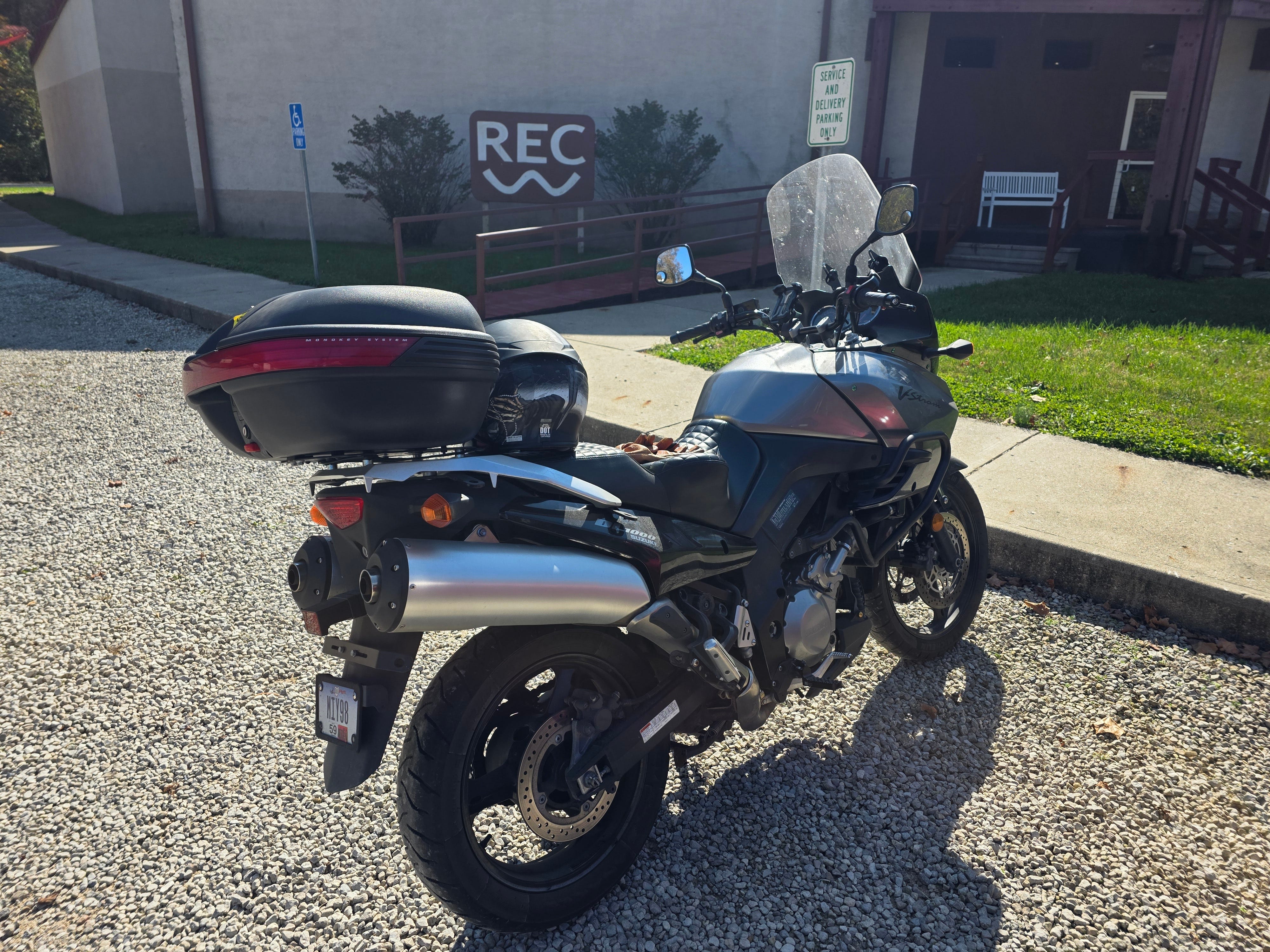
This particular V-Strom is in beater condition and I’ve had to perform a couple of different odd fixes to keep it going, the most embarrassing of which is a duct-tape strap I made to keep the airbox firmly planted on the front throttle-body intake trumpet. Yet it’s pretty solid for having 24 years and almost 50,000 miles on it. On Friday I rode it 261 miles to visit the Recording Workshop in Chilicothe, OH. I encountered everything from dead-stopped downtown traffic to winding rural roads; the Strom handles it all with aplomb. I really like this motorcycle, and I respect its abilities, but finances permitting I would happily replace it with a newer one, or a better ADV bike from a different manufacturer, and not think twice about it. I don’t love the V-Strom, I do not adore it, I do not yearn for it.
Instead, I’ve fallen, madly so, for its sister.
$1500 was enough to take this SV1000-with-stories home last December. It is now a $3,254.45 motorcycle, not least because it’s rolling on a proper new chain and Pirelli tires. It uses a 120hp variant of the 996cc L-twin that makes 100hp in the V-Strom, 125hp in the famously-deadly TL1000S, and 135hp in the less-deadly TL1000R. We live in an era of 200-horsepower motorcycles now so this unfaired Suzuki, which wasn’t considered rapid on its debut 23 years ago, is now just slow.
Except it’s not slow. This isn’t a color magazine so I won’t try to shine you on with some dumb-ass story about how it can drop a proper superbike on a back road. It absolutely cannot. Point to point it is slower than a Super Blackbird, even when those points are connected by marked 25mph and 35mph corners. But the way it makes pace is very different. Like the V-Strom, it lives for the middle revs — but because the power-to-weight ratio is 3.9 pounds per horsepower instead of 5.3, it has a vastly sharper response. Because that response is also dead-predictable, you can roll the throttle on in the middle of a corner without worrying about making a big mistake the way you might in, say, a Yamaha R1.
It never feels down on power, it never makes you wait. It’s the opposite of a high-strung inline-four or, say, a modern McLaren. It has the right-now arrogance of a big-block musclecar… without the breathless top end. It runs to 10,000 with no hassle and that’s when you want to shift, because the last 1200rpm to the redline don’t get you much except more deranged noise.
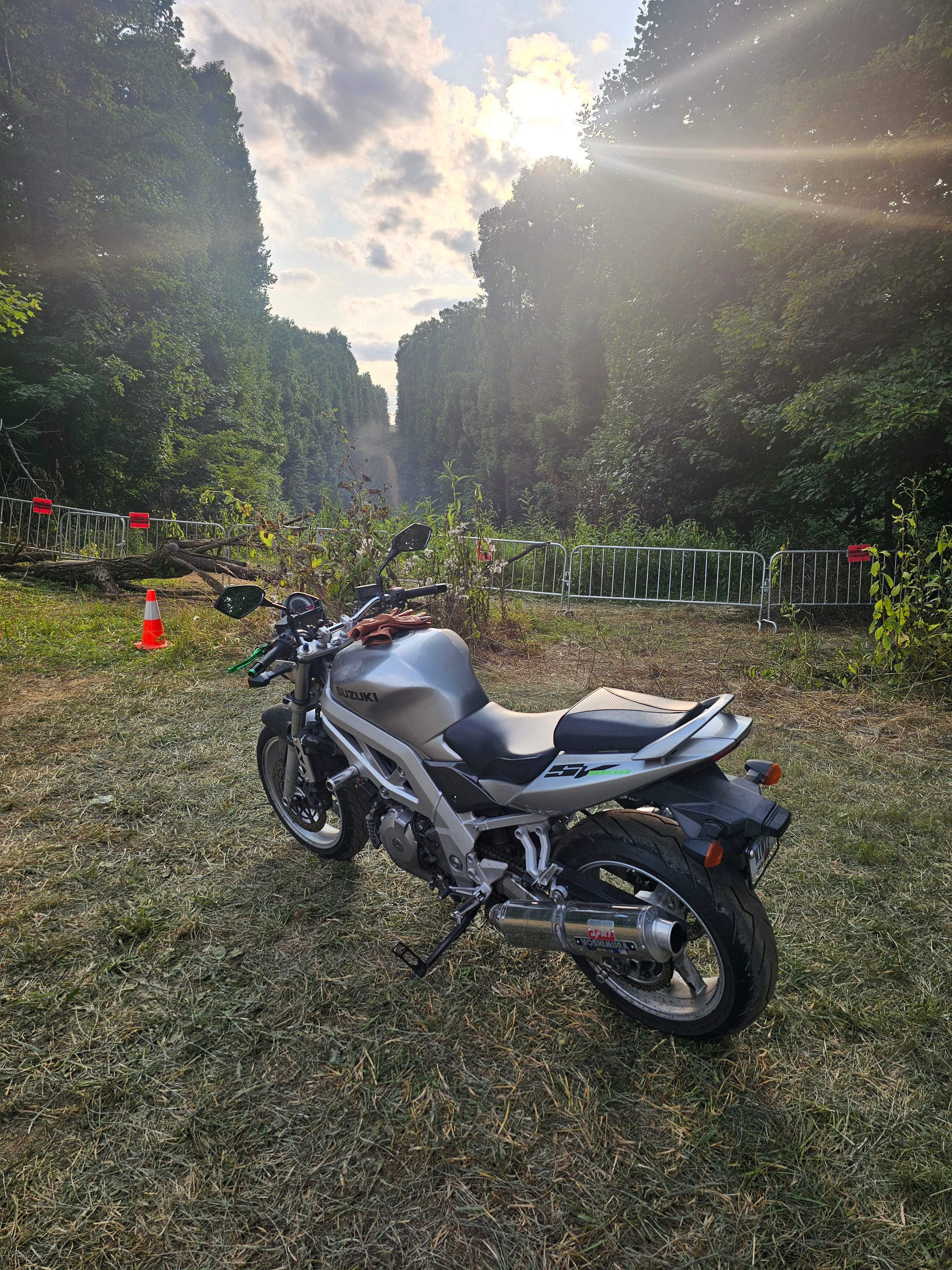
The perception of this power and rapidity, if not the reality of it, is massively aided by the antisocial and absolutely uncorked dual Yoshimuras fitted by a previous owner. Which is part of the reason why the SV1K is so much fun. It looks like a Universal Japanese Motorcycle, but it sounds like a twin. An angry twin. You can rev it at a stoplight and the vibe is Harley, but make it stouter. It sounds more like a “chopper” than a Pan America does, by far. There are always a few Harley types walking around downtown Mansfield, Ohio and I’m in the habit now of locating them visually then revving the Suzuki then watching their heads swivel around looking for the invisible Road Glide CVO or whatever.
There’s nothing significant to dislike about the SV1K. The brakes are really good, which is not something you can say about the V-Strom. There’s no ABS or electronic throttle control but I don’t ride hard enough to need modern six-axis ESC and I have thirty years of experience riding in the rain without ABS. I find the riding position to be exceptionally comfortable for up to an hour at a time. Visibility is good. Fuel economy is in the low forties when I’m cruising and low thirties when I’m hustling. It costs me a grand total of twenty-six dollars a year for liability insurance; that amount gets me four days’ worth of full coverage for my Chrysler 300C.
Yesterday I discovered that it won’t run right after being power-washed. I didn’t know this before because I hadn’t power-washed it since I took delivery in 2024. The V-Strom had also not been power-washed before yesterday. I don’t pamper these bikes the way I do my ZX-14R. That’s freeing, too. You can park the SV1K somewhere and not worry about it. Who would steal it? It has visible loose wiring dangling off the engine. (Come to think of it, that also might be why it didn’t run on both cylinders until it was completely dry.)
I look forward to every moment on the SV1000. I love the way it falls into a corner. They say the SV650 is better in that regard but any man who could have an SV1000 wouldn’t have an SV650, surely. I feel young on the bike, it’s a willing partner and friend, it comes awake and roars at the apices of my little backroad path to lunch.
My unbridled adoration of this thirty-two-hundred-dollar Suzuki makes me wonder what I could buy for more money that I would enjoy still more. The answer isn’t quite clear. I don’t like Mini Danger Girl’s Ducati Monster nearly as much, and I also don’t really enjoy the big-bore high-horsepower Monsters because the riding position is unhappy for me after a few miles. No one else makes a “naked bike”, which is to say a sportbike with conventional handlebars and no fairing, as a V-twin.
I suspect the correct answer is to find a mint-condition 2003 SV1000 then throw the kitchen sink at it. They can make a fair amount more power, there’s race-level suspension available for them, and of course it would be super-nice and quite fancy to have an example of the model that does not have a significant dent in the tank. Probably for ten grand I could build a 150-horse bike with custom paint and switchgear that hasn’t faded to flat grey everywhere the sun can touch it.
Alternately I could just shut up and ride this one until I can’t comfortably swing a leg over it. Surely that day is not far. I’ll turn 55 next week. As Donald Trump once said about a seven-year-old believing in Santa, at fifty-five it’s marginal to keep ripping a sportbike around, whether it’s a 208-horse hyper-Ninja or a 120-horse L-twin Suzuki. There are two statistically significant paths ahead from here. One is labeled “Honda Gold Wing” and the other is labeled “Dead”.
One day you wake up and you’re part of the old guard. I think of myself as a novice motorcyclist, someone who is still learning, still able to improve. These ragged silver Suzukis are part of that. Together they’re worth less than a standard Omega Speedmaster. Or at least they’d be worth less than a standard Omega Speedmaster to someone else. There’s a sort of joy in that, I think. In being nearly valueless, but perhaps not to everyone. Hell, even if you are valuless to everyone. The late C.G. Hill, friend to ACF and many others beside, once wrote about love and wistfulness like so: “And if I ever felt that way about anyone — well, it hardly matters now.” When I was still a callow kid on my Ninja 600R, I would occasionally see the superannuated Aerostitch crowd on their BMW R-whatevers and sneer. Who cares about those old guys, those old bikes? Probably — nobody. Now that I’m on the other side of that visual, I realize that I was right. And there’s a moment in every fast corner when you can feel that lack of remaining value like the bitterness of old tobacco on your tongue, when you realize that most of the people who ever gave a shit about you have long since given up and moved on, that as Townes once said you are not needed now.
Ah, but in that same moment you can put the weight of five additional feathers on your right wrist, stand the bike back up, and thrum your way out: to the next turn, the next road, the next and next and next, the resolution of an equation containing zero value, zero inertia, and seventy-five pound-feet of torque. Trust me, you can’t get that from an inline-four. Twins: it’s the last love story.
"You're not a fag, are you?"
The questions asked to so many young men in the 80s and early 90s who unknowingly made a questionable clothing purchase, turned up at a gathering with a new haircut, or, yes, rode the wrong motorcycle. Was a great way to prevent purple hair, noserings and being a furry.
After almost dying recently...
I suspect the best gear in sports* is the gear that gets you home alive. My dorky mini grigri works; it's small enough to carry, and I'm okay with that. So now worry about riding something that lets you live.
* "Of all sports, only bullfighting, mountain climbing, and motor racing really try a man, that all the rest are mere recreations; games that children play" -Ken Purdy