

Let me admit this right up front: there was no reason for me to go see Christopher Nolan’s “The Odyssey”. I have no patience for Redditors and the like whose response to every new denigration of Western culture is “Just go CONSOOM THE MEDIA before you judge it.” We don’t treat any other product like that. Imagine telling someone “I think the new Ferrari Luce is awful,” and having them respond with “Wellllll… you really need to pay $640,000 for the thing before you decide you don’t like it.” The Hollywood machine can’t tell the difference between “NPC rushing to the newest capeshit” and “critical thinker giving a fair shot to an obviously ridiculous idea”. The money spends the same on their end. You are under no obligation to pay money for any product that is obviously designed to upset and/or annoy you.
That being said, I had a few friends who really wanted to see the film and I am also a big fan of not letting politics or social positions affect my real-life relationships, so I grabbed the proverbial popcorn and sat down for the worst Christopher Nolan film of all time. And that includes “TENET”.
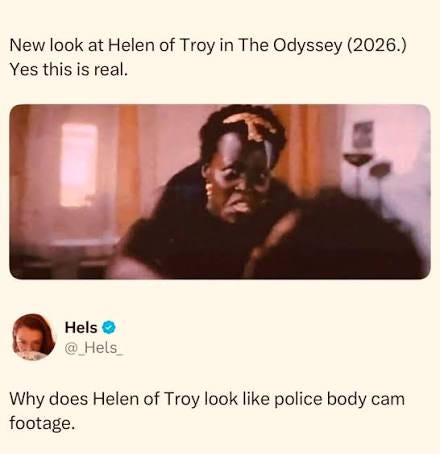
Much of the discussion surrounding “The Odyssey” has focused on the incomprehensibly “DEI” nature of its casting, which demeans both the original roles and the unfortunate people compelled to inhabit them here. Everyone agrees that Lupita Nyong’o is a talented person with her own sort of beauty; why force her to play two famously flawless Greek women? Let’s not forget that both of her characters are cousins to Penelope, played by Anne Hathaway. It’s just senseless.
There’s a strong devil’s advocate position to be made here, and it goes something like: The Odyssey has been cast as a play since time immemorial and very rarely has it had an all-Greek cast. Diane Kruger was German, not Greek. There is also a long Hollywood tradition of ignoring and/or playing with ethnicity. James Caan, a Jew, played an Italian in “Godfather”, next to Robert De Niro who then turned around and played a Jew in “Casino”. Charleton Heston played the Jewish Moses and Yul Brynner played Ramses. If you are looking for strict adherence to ethnicity in movies or theater, you will never find it.
Similarly, I can make an argument for the other much-criticized casting of biological woman Eliot Page as the Greek soldier Sinon. In Shakespeare’s time, they had boys play the female roles to avoid societal upset. So now we have girls playing boys to avoid societal upset, or something like that. The Elizabethans were moral degenerates, too, just like modern Americans. It was just expressed differently. It was also played for laughs: part of the hilarity in As You Like It comes from when Rosalind pretends to be a boy. Historically, that part was a double blind of sorts, with a young boy playing a woman pretending to be a young boy, and even the less sophisticated members of the audience could enjoy it.
Make no mistake, if you were to show any movie based on classical literature to, say, an Englishman of the seventeenth century, he would be horrified at all the intra-European miscasting. “Why is that German playing a Frenchman?” and so on. Two hundred years from now, maybe our descendants won’t blink at a remake of “Boyz n The Hood” with a white Tre and a Doughboy played by a six-armed alien from Acturus. “Either they don't know, don't show, or don't care about what's going on in the hood,” the three-foot tall green creature will intone through a quantum translator box strung around its second neck, and some woman in the audience will start crying.
In 2025, however, this sort of casting-for-shock-value should be taken for what it is: a deliberate attempt to shock the normies and piss in the faces of the people who pay for tickets. It does not deserve support nor approval. Perhaps it was meant to draw attention away from the rest of the casting, which is just incompetent.
A 55-year-old Matt Damon playing Odysseus? This is bad comedy. Odysseus is supposed to be an intellectual, a trickster of sorts, who is in his twenties when he is called to the Trojan War. (Which he initially tries to draft-dodge, by the way, something that is ignored in the film.) Matt Damon is such a stupid-and-bland-looking person that he became famous in “Good Will Hunting” for playing a character who couldn’t possibly be smart because he looks so dull. It is anti-casting. For the record, I’d argue the most convincing Odysseus ever is George Clooney in “O Brother, Where Are Thou?” That’s the man depicted in the poem: an amoral braggart on the road to redemption.
The immensely dislikable Jon Bernthal, a fellow who looks so unpleasant that you can kind of forgive his co-workers in “Wind River” for beating him to death, shaves his head and plays Menelaus as a sort of wisdom-infused Andrew Tate:
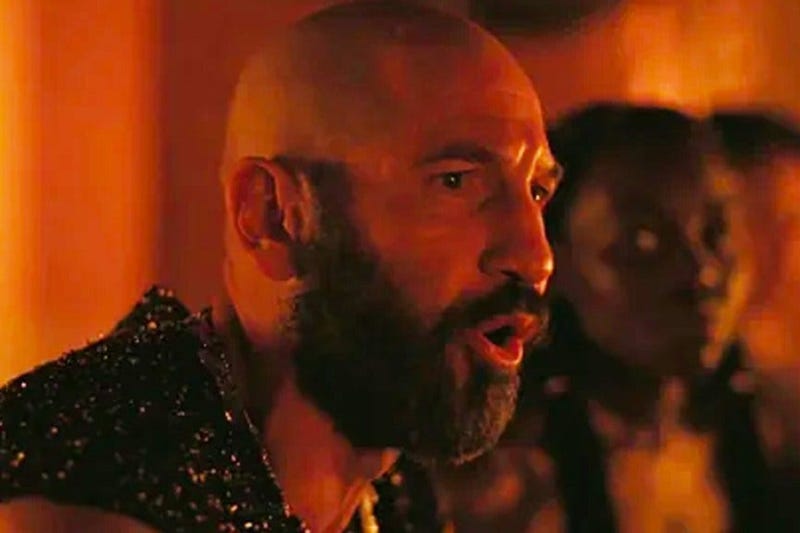
This is presumably meant to be an in-joke — the biggest cuck in Greek literature looks like Tate! — but the unexpected effect is that you kind of feel sorry for the guy even if he did decide to cut up his wife’s face after the war.
Then you have Agamemnon, who in the source document is an arrogant and overly driven man who nevertheless engages fairly with his people, even recognizing a mistake he made with his finest warrior, Achilles. In the movie, on the other hand, he is basically Darth Vader, especially in this, the most evocative scene in the entire film:
You never really see his face, which doesn’t make sense in the film but makes sense once you realize he’s played by this guy:

Why? Why not! Why not have a vaguely fey Jewish guy play the King of The Greeks? As for Achilles, he is essentially written out of the film. Which would make sense were “The Odyssey” restricted to the events of the original poem, but it is not; we get parts of the Iliad and Aeneid as well in the film.
Eurylochus, who is a coward and saboteur in the poem, is played as a heroic moral touchstone by Himesh Patel, because of course you can’t have the leading Indian be a piece of shit in a film that you want to sell to 1.4 billion English-language viewers. The goddess Athena is played by Zendaya, which is just silly.
On the other hand, you have Ryan Hurst as Mentor — excellent choice — and Anne Hathaway as Penelope, which is pretty good.
We could forgive all of this casting drama were the core film as well done as “Inception” or “The Dark Knight” or “The Prestige”, but what Nolan gives us is an “Odyssey” without a plot.
If you’ve never read the original Odyssey, it’s worth your time. It is not equal to the Iliad, not close, but it has a sort of majesty in its own right. At its heart, the Odyssey is a story of how the gods humbled a bad man and taught him to be a good one. It details how a “trickster” became a righteous king and reunites with both his son and his father. Which is why “O Brother, Where Art Thou?” is such a deft piece of filmmaking; it tells exactly the moral that Homer intended.
What Christopher Nolan gives us, instead, is a story of how a war criminal comes to regret his war crimes through a complicated program of letting his friends die and also getting high all the time with a really fine-looking broad. The political thorniness of Odysseus killing most of his most prominent, which in the poem is hand-waved by having Athena intervene, is dealt with via a ridiculous subplot of his son not participating in his revenge, at which point the son becomes king and banishes his dad.
All of this rings false. We are meant to believe that Odysseus is emotionally undone by watching the Greeks ravage Troy — but only the biggest of fools couldn’t have predicted this would happen, and in any event Odysseus is far from a naive kid when it happens. He has already been at war for ten years. Nevertheless, seeing the sack of a city makes him secretly not want to go home. His subsequent behaviors get everyone around him killed. Then one day he wakes up and goes home, in quite excellent physical shape by the way.
This is nothing that the ancients would recognize as a story. There’s nothing human about it. Instead of a redemptive tale, we get a mopey violence addict surrounded by special effects. His wife is devoted to him, but we can’t help but wonder why. His son doesn’t know him. His eventual triumph just comes from being a better archer than his opponents; that’s the sort of detail on which nothing more serious than a Hong Kong action flick should hang.
Nolan had the choice here between making a historically faithful film and making one that would resonate more strongly with modern audiences. Somehow, he chose neither. Damon is not one percent more sympathetic in this film than he was in “The Departed” — you know, the one where Marky Mark kills him and the audience cheers. At most, it’s a parable about medicinal marijuana: it will help you forget war crimes and also have sex with hot women but it will somewhat delay the day where you become a homeowner.
If you haven’t seen “The Odyssey”, there is no need to. I would recommend the Wolfgang Petersen “Troy” instead. That film is superbly cast and although it is not “great cinema” it tells the story pretty well.
Just try to forget the part with the rubber helmet, and you’ll be fine.
Oh, and if you’re a devoted Christopher Nolan fan who wants to witness a redemptive arc of an amoral “trickster” who winds up facing his own flaws, good news: he already made that film. It’s called “Inception”. Watch it again, and thank me later.
Apropos of nothing, it seems like over the last month I keep seeing "Chris Nolan Chris Nolan Chris Nolan Chris Nolan Chris Nolan" FREAKING EVERYWHERE.
No idea who he is.
And don't care. You don't need to tell me lol.
I had to read Odyssey in high school and found the prose unbearably tedious back then. I certainly won’t go see a version staring an ugly black chick now because all the lefties hate Sydney Sweeney because she’s unapologetically hot.