


Before we start, a note to readers: 13% of ACF subscribers reside in India. A significant percentage above that are Indians residing in the United States. For reasons of coincidence and timeliness, we will have topics both today and Wednesday involving Indians who live in the States. I’m going to remind all of you that no one wants to be judged by the worst foot put forward by his countrymen. William Calley was an American. Jeffrey Epstein was an American. Jonny Lieberman is an American. American soldiers in the “Greatest Generation” raped more than 14,000 German women while “liberating” Germany. We can discuss a situation, or a problem, without descending into Redditor tirades. That’s all. As always, thank you for reading.
Guitar Center wants you to design its products, then buy them
A few weeks ago, my son wanted to “busk” in Washington Square Park. We had an acoustic guitar and an electric bass with us… so we needed a travel-ready bass amp. There was a Guitar Center in Newark, NJ so we headed over there, got some useful advice from the kid working the guitar section, bought a Fender Rumble 25 for $149, and took it to the park, where it worked very well.
If you’re a Business Idiot (about which more on Wednesday), you no doubt read that paragraph and thought, “Why did Fender get a cut of that? Guitar Center was their only choice to buy an amp in the Tri-State at 8:35pm on a Wednesday night. Why should Fender get paid?” Honestly, it’s a good question. Guitar Center has managed to outlive its national-level competitors and become the only major music retailer with a dependable brick-and-mortar presence. If you need new music equipment, or if you are new to playing music, you are almost certainly going to deal with GC sooner or later. It doesn’t matter if the retail location carries Fender, Gibson, or PRS. You are a Guitar Center customer, not a Fender customer.
Sam Ash, Guitar Center, and Sweetwater have long engaged in serious house-branding shenanigans with stuff like music stands and other accessories, but now GC is going to go the rest of the way and make… a Guitar Center guitar. So they’ve asked their customers to chime in about what they want. Which seems reasonable. They’ve even opened up a subReddit… which has been promptly overrun by people whining about the existence of the subReddit. As you’d expect, even the helpful suggestions are schizophrenic; at the time of writing, the suggestion “Built In Wireless Connection To Amp” is running neck and neck wit the suggestion “Keep It Simple”.
The whole exercise has me thinking about more than just the guitar business, which — let’s face it — is already way past its peak earning years. In the beginning of the Industrial Revolution, distribution was key. You either bought what was available at the local general store or you shopped with Sears Roebuck. In both cases, your choices were entirely determined by the distribution channel. The brand of the product hardly mattered.
From 1930 to 2010 we had kind of a Golden Retail Age where there were a lot of brands with a lot of brand image and there were a lot of retail outlets. So you might decide to always buy Milwaukee tools, but from multiple sources. Or you might be the kind of person who always goes to the Home Depot. You could choose your strategy. My local “mall town” of Ontario, Ohio is a great example of this. We have a Home Depot, a Lowe’s, a Menard’s, and an ACE Hardware.
Ah, but in the long run these four channels will almost be certainly optimized to one. So if you’re shopping for home improvement, you will have to buy whatever that single channel wants to sell you…
…except you will also be able to deal directly with your favorite brand via an optimized online sales channel.
In the middle of this, you have Amazon, which rose to power by carrying all brands but is now engaging in actively predatory behavior against those brands in favor of its own partners. Amazon is very smart and they know how to calculate costs. It is very hard to make huge money selling anything through Amazon, the same way Wal-Mart was famous for making manufacturer reps stand in empty rooms for a while to soften them up before the pricing discussion.
In light of this, Guitar Center is smart to get into the guitar business itself. Fender, Gibson, and PRS have nowhere else to go anyway. Not if they want a brick and mortar retail transaction. If the Guitar Center Guitars are decent enough, they will succeed for the same reason the Chevrolet Equinox is always a best-seller; that’s what’s easiest to buy.
Some of you will note that this model has kind of been done before, via St. Louis Music and its in-house guitar brands “Alvarez”, “Electra”, “Westone”, et al. It was a raging success, undone only by a sharp increase in the dollar-to-yen ratio. Your humble author started his career on an Electra. It could just as easily have been a Guitar Center Whatever.
Knock, knock
Okay, he is the actor son of a director mother — but this is great politics, and it’s brilliantly done. New York City has started their pied-a-terre tax, which is aimed at people who own expensive properties in the city but do not live in the city full time. Because the city vastly underrates the value of its own property when doing tax assessments, its most public target — Citadel CEO Ken Griffin — will only pay an extra $1.4m in tax a year on apartments that together are probably worth well over half a billion dollars.
About 10,000 properties are expected to contribute about $500 million a year in total to NYC’s annual tax-and-spend budget of $124.7 billion dollars. That is an insane number, by the by; only 8.5 million people live in the five boroughs, so that works out to almost fifteen grand in services per resident. By contrast, the state of Ohio spends $60 billion every year on 11.9 million people, a rate of five thousand dollars per person. For context, the real estate in New York City is worth approximately four times as much as all the real estate in Ohio, even if you count my farm.
I will admit to being hugely conflicted about the idea of taxing people just because they don’t live in New York. I believe that the power to tax is the power to destroy, that governments are rarely more efficient than markets, and that if you start by attacking billionaires you might easily wind up killing people just because they wear glasses. On the other hand, I think that when someone eats up half a billion dollars’ worth of real estate to not live there, it has an awful trickle-down effect. The $150M place becomes the $250M place, the $75M place becomes the $150M place, and at the bottom you pay $1.6 million, which means $14,071 in monthly payment, which means a minimum suggested income of $550,000 a year, to live on the block where Ron O’Neal gets attacked in the movie “Superfly”.
Oh, and at that income level you can’t actually afford to eat on 125th Street. Even the Popeye’s down the street charges almost 2x Ohio prices.
Mamdani’s actions here will reduce the value of NYC real estate. Which is almost certainly a good thing. But he’s coming at it from one corner of the demand equation. Let’s see what happens when you come at it from another corner:
Are you going to scam in Fricso? Be sure to wear some flowers in your hair
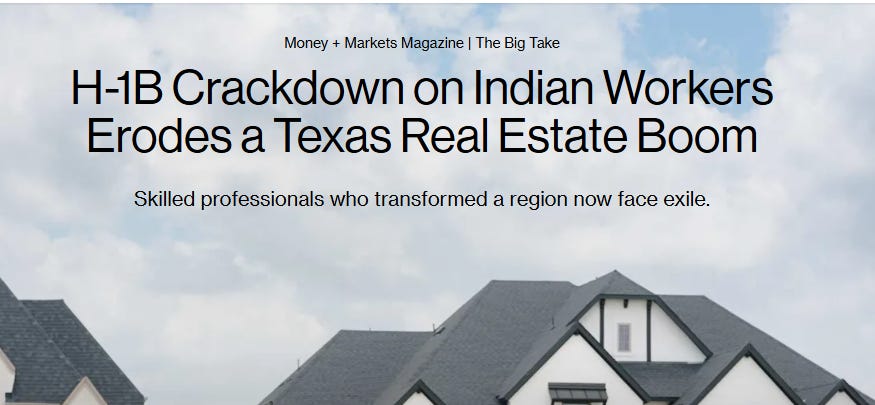
If you’re like about a third of ACF readers, generally among the more successful and educated cohort, you might wonder why your fellow commenters occasionally break out into an anguished chorus of “these people want you broke, dead, your kids raped and brainwashed, and they think it's funny.” Perhaps the Bloomberg approach to the “Texas Real Estate Boom” will help you understand:
Since 2018 the Dallas-Fort Worth metro area has attracted more corporate headquarters relocations than anywhere else in the US... The influx drew thousands of software engineers and other Indian-born workers to the federal H-1B program, which provides temporary (FUCKING LOL — jb) visas for professionals with corporate sponsors… Collin also had the biggest percentage jump in Indian residents among large counties, climbing to an average of more than 116,000 in the five years through 2024, from 70,000 in the preceding five years.
But the momentum is quickly reversing. Indian buyers are disappearing from the market as federal and state governments tighten H-1B restrictions and many of the tech companies that employed the new arrivals fire workers in favor of artificial intelligence. Prices in the Collin County suburbs north of Dallas in February dropped almost 9% from a year earlier, compared with a decline of 4% in the metro area as a whole, according to data from brokerage Redfin.
The shift has knocked down home prices, slowed population expansion and risks eroding the tax base needed to fund schools and roads planned during a five-year growth streak. The changes also take a personal toll on immigrants because many have lived in the US for years and have established families and communities.
South Asians have become the most important first-time buyer group for builders, says Alex Barron, an analyst at Housing Research Center LLC in El Paso, Texas. “Who is there to replace them?” he asks…
One client, a senior IT director with two homes worth more than $1 million each in Frisco, is considering selling both and moving back to India. Another financed an $800,000 home almost entirely with debt. It’s now worth less than he owes, and he might just hand over the keys. “He will not lose anything,” Gupta says. “The banks will lose.”
This dude has two million-dollar homes? Give him the pied-a-terre tax, now. How did he get two of those homes? The federal government, which effectively sponsored his arrival to the United States, and which taxes his employer less on him than they do on an identically compensated American citizen, also probably backstopped his loan:
During the Biden administration, H-1B visa holders were buying houses with 97-100% financing. 97% would come from the FHA, with the rest coming from state first-time home buyer programs.
Zero money down. Thanks to programs that were supposed to be helping low-income American families buy their own homes.
FHA loans to non-permanent residents quickly grew to represent 6% of mortgage issuances. The percentage was undoubtedly higher in places like the DFW area, where H-1B visa holders are disproportionately concentrated.
This is a gross misuse of Federal funding and it is an astounding betrayal of American citizens. Some people, such as Ohio’s appointed next Governor Vivek Ramaswamy and our own “Sherman McCoy” would have you believe that Americans are lazy, entitled scumbags who bray about “JERBS” while erecting barriers against hard-working immigrants who more truly represent the American Dream than any trailer-trash possibly could.
The reality of the situation is that our government has stacked the deck against employing Americans for more than twenty years now. Compared to an American worker, an H1-B costs less to hire and less to employ. He is also unable to participate in most labor protection schemes and/or complain to the DOL about what you do.
Even if you don’t care about what this does to Americans, think of what it does to the H-1Bs. Their residency status is tied to employment. If they displease their employer — say, by refusing to work sixty hours a week while putting just forty into the timesheet, or by refusing to do anything else at all — they can be deported with very little notice. This happened to a woman which whom I worked at Recursion Phamaceuticals a few years ago. They told me to use an 18-foot ladder to fix networking equipment in the ceiling at night. I told them to fuck off. So they made poor young Deepika do it. Night after night she tottered at the top of a ladder, alone, troubleshooting CAT 6 cable, while I rode my Super Blackbird to In-and-Out Burger and read the classics until I fell asleep.
When she finished the project, they terminated her without severance. She then had 90 days to find another job or be sent home with nothing.
So the government and the major corporations basically work together here to remove even the pretense of protection from white-collar employees in multiple industries from tech to medicine, while at the same time making the business case for hiring foreigners damn near unassailable.
The Trump Administration turned off the “FREE MONEY TO BUY A HOME” spigot. Now they are looking hard at H1-B abuses. They aren’t cutting H1-B, they aren’t getting rid of it. They’re just looking at people who are scamming it. And the net effecct of those two changes — no more free house money, no more free scam money — has the home market in Frisco, TX down nine percent!


The rest of the Bloomberg piece, which is written by Bloomberg contributors Prashant Gopal and Tanaz Meghjani, is a bunch of sob stories about foreigners who bought million-dollar homes and now have to sell those homes for their purchase price, thus denying them the chance to make real-estate money after years of making minimal payments on 100% subsidized loans.
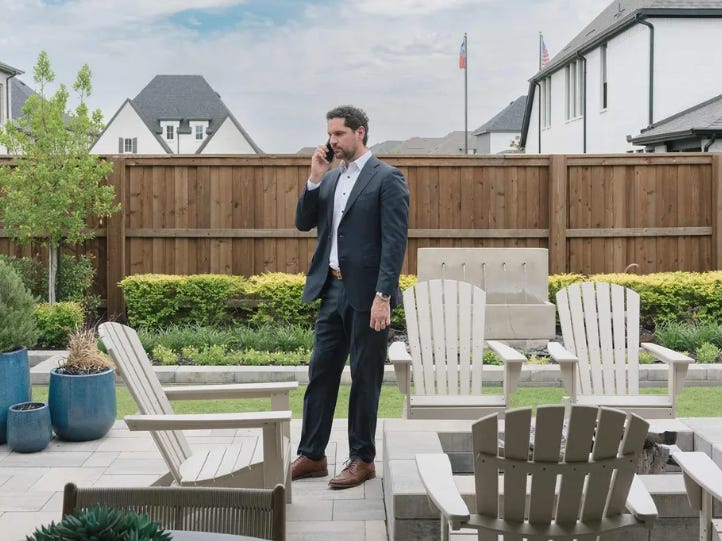
Oh, and you’re also supposed to feel sorry for some jerk-off home builder who is sitting on an inventory of 125 luxury homes under construction. I hope that dude accidentally falls into a woodchipper. Alternately, I hope he gets e-Verified so hard they throw him into prison so MS-13 can rent his ass to the brothers. If you want a picture of the modern “hustle culture business superstar”, it’s this guy: he illegally employs Mexicans to build homes for Indians, the federal government throws money at him, he thinks he’s brilliant for accidentally participating in the most corrupt process since Martin Luther heard the word “indulgences” for the first time, and he still can’t find pants that fit.
In the same way that a $238 million penthouse purchase makes it impossible for a garbageman to own a home in Queens, a never-ending tide of federally-funded immigrant homeowners makes it impossible for working people in Texas to own a home. If you’re tempted to reply something along the lines of “Those working people in Texas should just work harder,” then congratulations on never opening a history book of any sort. The average Middle Ages peasant had more autonomy and more freedom than the average service-class worker in 2026. And those service-class jobs are increasingly impossible to get.
But here’s the scariest part: Zohran Mamdani wasn’t elected in a vacuum. He was elected to pursue an explicitly socialist agenda — for God’s sake, he quoted Eugene Debs on Election Night — because the man in the street is sick of $238 million penthouses. Americans, by and large, tend to be optimists. I walk into the Vacheron Constantin store and I think, “You know, with hard work and luck I’ll have one of these.” You see an S-Class roll by and you think, “Hey, I might end up buying an S-Class some day.” For the last 150 or so years, we haven’t had an outright populist riot with public executions in this country because we have maintained the fiction, however paper-thin at times, that anyone can make it.
The prevalence of $238 million penthouse sales, combined with ever-worsening economics down here on the ground, threatens to tear that paper-thin fiction into shreds. You can argue it’s already happened to some extent, because we have a Muslim socialist mayor in the world’s greatest city.
Now, when the same illusions are shattered in Texas, you’ll get a different kind of protest vote. Or you might get no vote at all. You might see people simply acting out in all sorts of ways. The media, the Bloombergs of the world, will be shocked. Because they’ve witnessed a lead pipe being taken to the skulls of the middle class and lower middle class in this country since 1990 or thereabouts, and they thought the beatings would never stop.
And it’s true: the beatings never stop. But they are occasionally shifted.
Don’t let them see my Affirm statement
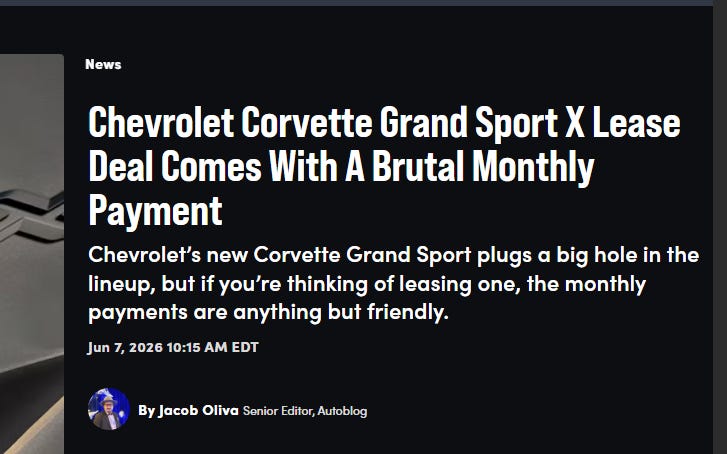
The automotive journalism business continues to be operated by people who neither drive cars nor buy them. The latest news from Autoblog about Chevrolet’s Corvette lease program is proof positive of this:
According to CarsDirect, which got its hands on dealer lease bulletins, Chevrolet’s first national lease offer for the 2027 Corvette Grand Sport X is $1,799 per month for 39 months, with $3,839 due at signing. The offer is based on a vehicle carrying an MSRP of $112,195 and includes an annual mileage allowance of 10,000 miles. Factor in the upfront costs, and you’re looking at about $1,897 a month before taxes and fees.
According to the report, the main reason for the towering monthly payment is the sky-high lease rate that translates to a 10.44% APR. Chevrolet isn’t offering any lease cash, loyalty bonuses, or discounts to soften the blow either. The only thing in your favor is a solid 63% residual after 39 months.
When I see stuff like this, I ask myself: How stupid are these people? I don’t like the Grand Sport X, and I don’t like hybrid Corvettes in general, but as deals go, this is one. Let’s look at the numbers. If you do this deal, you will hand over a total of $74,000 across 39 months, plus taxes. Your residual will be $70,683.
Compare that to a five-year purchase, which would cost you $2,225 a month without tax. That’s an extra $16,614. At the end of 39 months, you’ll still owe $43,775.
If the Grand Sport X turns out to be a resale superstar, you’ll want to have purchased it, because at the 39 month mark you could be up to five or six grand ahead depending on what else you could do with the money you don’t pay during the lease term. But I don’t think it will be a resale superstar. I don’t think the average Grand Sport X will be worth seventy grand after more than three years. But if it is, guess what? You can buy it for the residual amount and flip it!
Five grand over 39 months is… $128 a month. That’s not a lot of money to risk in exchange for the chance to walk away from a hybrid Corvette around the three-year mark. In my experience, a three-year lease payment should be slightly less than a five-year purchase to make economic sense. In this case, it is a lot less. So Autoblog is wrong…
…but I don’t think they made all of the above calculations. I think some dumb-ass who has never purchased a new car in his life saw the figures and thought OMFG THAT IS SO MUCH MONEY. No, friend, it is not. And especially not on a car that costs over $110k.
To put this in perspective, when I was in the methadone clinic game we had a pair of leases out on $70k Range Rover Vitesses. Each lease was about $1600 a month. We considered that to be a deal because we in no way wanted to have a Range Rover Vitesse a single day out of warranty. If we could have gotten $112k cars, which back then would have meant “loaded S600 coupes with cash in the trunk,” at $1799 a month, I would have had three S600 coupes in my driveway. Alas, the average modern car blogger is just becoming an S600 coupe buyer now, when they’re five grand on “Cars and Bids”.
That’s all for now, folks — we will have a fun guest piece and an “Ask Jack” this week!
My friend lives in Frisco. He said it's been consistently getting $h!ttier with er, a certain segment of people who are stupid morons who can't drive, park or turn like someone who hasn't had a frontal lobotomy. If it wasn't for his business he'd joyfully move back to Wyoming.
H1B's need to be banned. Period.