

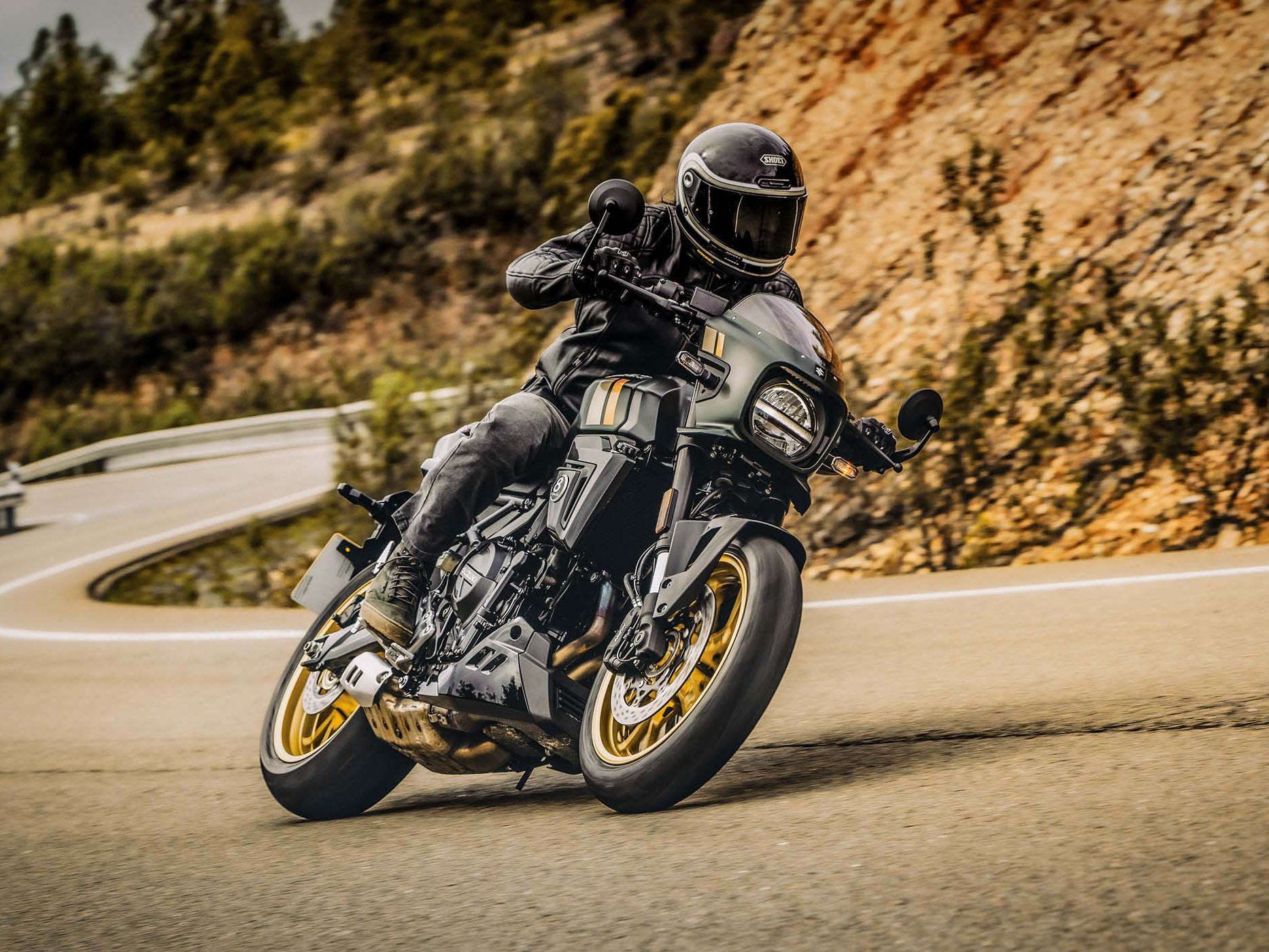
The minute I saw the new Suzuki GSX-8TT, I knew it was the bike for me. I’ve been dabbling in “retro” bikes for a long time, becoming a Honda CB1100 owner in 2015 and then putting a few hundred miles on the XSR900 and Z900RS afterwards, but none of the available choices is without flaws. The XSR900 has never looked right, while the CB1100 and Z900RS have never managed to beat 100hp at the rear wheel and therefore feel a bit weedy at times. The GSX-8TT, on the other hand, perfectly captures the modern/retro aesthetic, is priced fairly, and offers about 150 horsepower from a slightly modified version of the GSX-R750 inline-four. Sign me up; I’ll be paying with Affirm.
Er, wait. The GSX-8TT is not powered by a GSX-R750 inline four or any variant thereof. The unfaired 2020-2023 GSX-S750 was powered by a 114-hp detuned version of the 750 inline four turning 11,500rpm, so you might think that the new bike is at least that strong. Nope. This GSX-8TT, like the GSX-8T retro and the new GSX-8R, is powered by a 776cc 82-horse parallel-twin that chokes out at 9500rpm but makes peak horses even lower than that, at 8500rpm. Which means you can’t compare it to any GSX-R in history, really. Instead, you have to compare it to second-tier machinery like… uh… let me flip through Cycle World until I can find a mainstream Suzuki sportbike with this little power… okay, I found one that makes just a little more power.
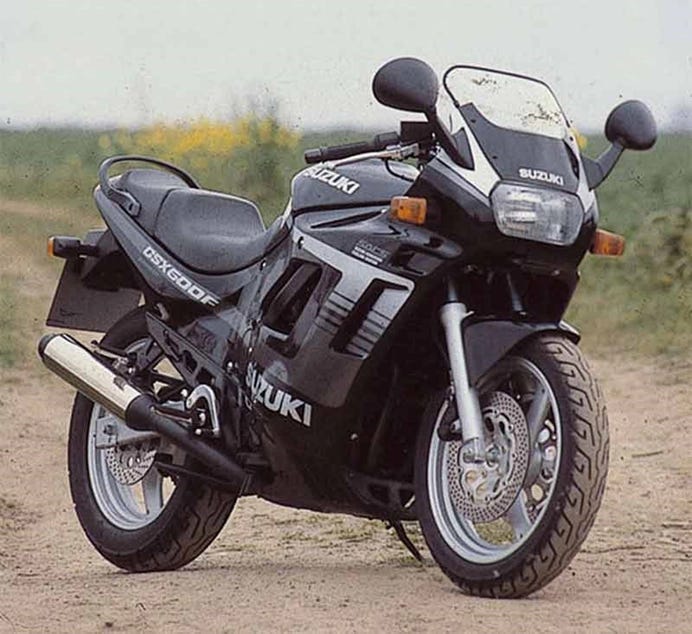
That’s a 1994 Katana 600, for those of you who didn’t immediately recoil in disgust when you recognized it. It was like a cheapie alternative to the GSX-R, and it made 86 horsepower to push 441 pounds. Oddly enough, this is just four pounds lighter than a GSX-8TT; I guess we’ve learned something in the past 32 years.
Anyway, the Katana 600 was a total sled, it got zero respect on the street. I was riding a 1987 Ninja 600R (75hp!) when the Katana came out, and I remember thinking “well, my bike is not fast, but it is also not a Katana.” The best thing you could say about the Katana was that it rarely got stolen despite the fact that it could be started with a screwdriver and a rubber mallet. People laughed at it because it ran a 12.1@111mph.
The new GSX-8TT runs… a 12.2@111mph. It has all the modern conveniences, it has a full LCD screen, it is Bluetooth compatible (I think), but if some kid rolls a smoking Katana 600 with tri-color eBay bodywork up next to you at the light, your first thought should be How can I get out of this situation with my dignity intact?
If this feels familiar — brand-new vehicles selling for top dollar with oddly strangled engines and a real lack of shame on the part of the manufacturer about it — well, it should feel familiar. Cast your eye down the following list:
Audi A4, A5, A6
BMW 330i, 430i, 530i
Mercedes C300, E350
Volvo S60, S90
Lexus IS300, RC300
Alfa Giulia
Jaguar XE, XF
Porsche Macan
Range Rover Velar
Cadillac CT5
Jeep Grand Cherokee
Acura TLX
What do all of these cars have in common? Simple: they were once powered by an astounding diversity of engines from inline sixes to VTEC fours to pushrod V-8s but they are all now shoved along by a long-stroke two-liter four-cylinder light-pressure-turbocharged engine. If you look at the specs, it is plainly unnerving just how similar they are:
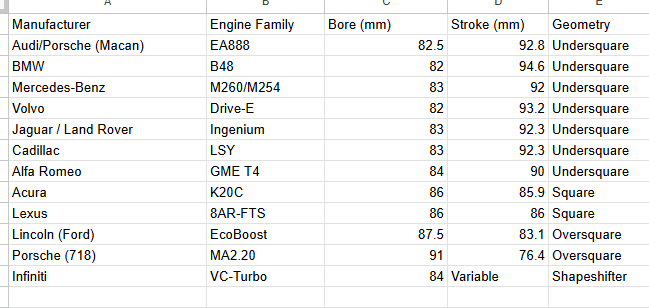
I tossed the 718 boxer in there so you can see what an engine looks like when the manufacturer wants it to make power. Other than Porsche (in their car), only the Japanese and Ford provide you with anything other than a plug-along small-bore choker.
Few engines are as unhappy in their work as a long-stroke four-cylinder. You get a real winner’s combination of “hates to rev”, “shakes like a Hitachi”, and “sounds like Jonny Lieberman watching Jason Cammisa videos with one hand under the covers”. The best you can hope for is an insulation and engine management package sophisticated enough to transform the driving experience into “moaning noises from a comfortable distance while you pick up speed at the approximate rate of a 2011 Accord V-6.” If your last impression of a two-liter turbo came from a Mitsubishi Evolution or something similar, expect a full Crying Game’s worth of unpleasant surprises once you start, er, going hard at it.
The automakers aren’t stupid. They know that no one wants these engines. They also know that the universality of the two-liter engine robs them of an important differentiation vis-a-vis the competition. (In the modern bugman-bossbitch marketing era, this is often seen as a good thing. “Make it the same as everyone else, we will win with a social strategy!”) But the low-rev four-banger has an important feature: it easily meets most taxation and emissions requirements around the world while putting up class-appropriate numbers. The current BMW 530i makes 255 horsepower. The 2001 530i made 225 horses from an inline-six, while the 1994 car made 215 horsepower from a V-8. If you close your eyes and try not to think about the 580-pound weight increase over the past twenty years, then the 2.0t comes across as not entirely unreasonable. It’s also dirt-cheap to build in bulk; I wouldn’t be able to accurately speculate about how much money you save by building one four-cylinder engine type for a car instead of three or four different architectures, but it must be something.
It is also worth considering that in the era of the electric vehicle, even the least compelling turbo-four has some charm to it. I happened to be on a rural two-lane yesterday behind some teenager in a BMW X1, powered by a 240-ish-horse two-liter. He was flooring it off lights and Steptronic-downshifting the thing like a madman, enjoying the hell out of what to me is kind of a depressing little wagon but to him is a real BMW powered by a real turbo gas engine. I could point out to him that I often had a chance to drive my father’s E30 sedans when I was that age, but it would be like showing him a chart detailing the average curb weight of a Kappa Kappa Gamma or Alpha Phi in 1989 and 2026; why steal the sunshine from our young men?
The new-generation parallel-twin is the motorcycling equivalent of the 2.0t, being an engine that no one really wants but which is nonetheless omnipresent in showrooms. And as with the 2.0t, there are regulatory and cost reasons for it:
It’s cheaper to make an upright twin than it is to make… almost anything else. A V-twin is far more complex, as is an inline-four.
Euro 5 requires that catalytic converters come up to working temp more or less immediately. A twin is very good at that.
Both cylinders cool at the same rate, which makes emissions management easier. They run at the same temperature, compared to an L-twin where you have a “hot” cylinder in the back.
It’s the easiest multi-cylinder engine type to package: narrow like a V-twin but short front-to-back like an inline-four. I also suspect it is more effective as a stressed chassis unit than any other engine format, since it’s closest to a square.
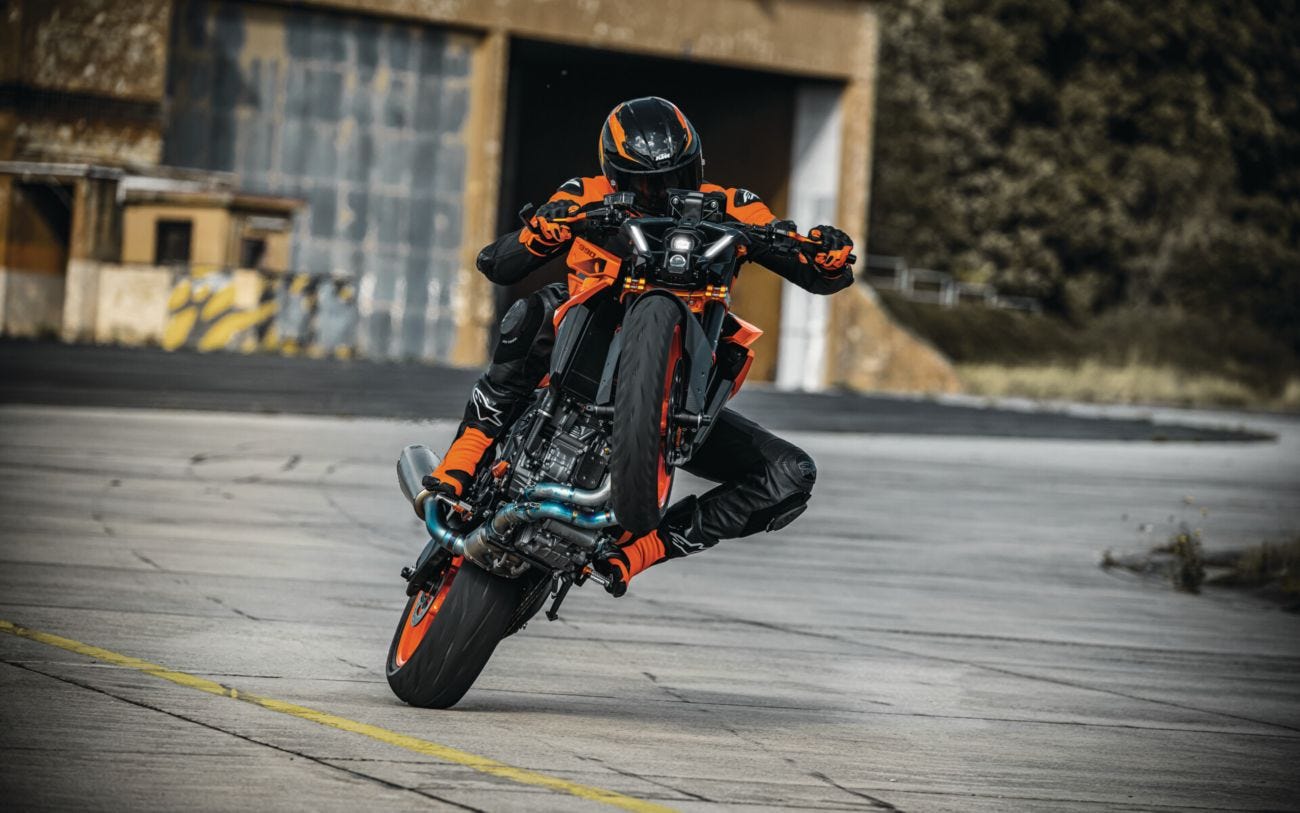
Yup, the parallel twin is pretty good at everything… except making power. KTM can get 140hp out of theirs, but if you look at the offerings from the other manufacturers, the results are just plain dire. Suzuki has built their entire middleweight lineup around that 82-horse twin. Honda claims 90.5 for the CB750 Hornet, which is only impressive if you compare it to a 1969 CB750 at 69 horses. Their most powerful p-twin, the 1,084cc model in the NT1100 and Africa Twin, maxes out at 101 horses. BMW can get you 105 from their p-twin, a Chinese catastrophe manufactured by Loncin. Yamaha offers 112 in the Super Tenere 1200 but just 75 horsepower in their family of middleweights like the FZ-07, YZF-R7, and XSR700. Kawasaki has their Ninja 650 and Z650, which make 67 horses.
As a result of this move to parallel twins, power outputs are sharply down across the board for the Japanese brands, especially in their volume models. The everyday sportbike from Yamaha used to be the R6, which made almost 120 horses from a 599cc inline-four. Now it’s the R7, which features a 15% price reduction and a 38% power reduction.
Go look at any 2010 lineup for a Japanese manufacturer; you will see a wild array of literbikes, 1300cc sport-tourers, V-twin sportbikes, and high-revving, high-horsepower inline-four screamers. Those products are pretty much all gone, replaced by a diverse array of two-cylinder motorcycles. At Honda, for example, there’s just one core product with four cylinders below 998cc: the CBR600RR, which has been an off-again, on-again product for Honda as they struggle with the mechanics of making an engine emissions compliant at 15,500rpm.
It’s safe to say that if you are shopping for a new motorcycle and your budget is $12k or less, pretty much all of your choices are going to be p-twins. (Unless you’re willing to consider the fantastic new Honda CB1000F, about which more will be said tomorrow.) So what are they like to ride?
As fate would have it, both of the ladies in my household are, or have been, p-twin owners. Danger Girl rode a first-generation Yamaha R3 for a while, and her daughter has a very fetching matte-white Ninja 500. The less said about the R3 the better, because while it is a great starter bike that is all it can accomplish. At 80mph it sounds like it is about to explode. Acceleration is fantastically modest. It also sounds and feels like a toy. With 42 horsepower, the most you can say about it is that it’s not dangerous to operate the way the old Honda 250 Rebels were; I can remember involuntarily falling below 55mph on my brother-in-law’s Rebel back in the day, going up a steep-ish hill on Route 71, and being fairly certain I was going to be killed by a semi-truck.
The Ninja 500 is less toy-like. It has 51 horsepower and a bit more substance to the frame. Kind of like a real bike. Maybe too much so. You can read a lot of anguished posts in the Reddit motorcycle forums: “I’m a 26-year-old powerlifter who wrestles alligators for a living. Is the 500 Ninja too dangerous? Should I get a Ninja 300?” We have done such a good job of terrifying our young men about everything outside an LCD screen. It makes me sick. The youth cohort has been artificially bifurcated into Dirty White Boy/Stunt Brother, doing wheelies in Harlem or Montgomery on a stolen Gixxer Thou, and Redditor/Mommy’s Boy who is afraid of the Ninja 500. Like most Gen X men, I was neither. The day I got my 600R I ran it up to the aero wall at 135mph, then was glad to slow back down. To this day I’m a fairly cautious motorcyclist, absent the occasional episode where I outrun police planes and/or almost fall off the back of an SV1000.
Maybe the Redditors are right to be afraid. Mini Danger Girl crashed her 500 almost immediately, albeit on gravel. It did not discourage her. She rides it like she is protected by a force field bubble. Last time we went out she gave it full throttle for the first five gears past the local police station. I could see people looking up the parking lot. There was nothing to do but twist the throttle on the ZX-14R and go get her. I don’t know how fast she was going — the nominal top speed is 120 — but I had to hit 140 or 150 to catch her from a quarter-mile disadvantage. That’s why God gave us the 1441cc motorcycle: parenting.
Bottom line is you can still get killed on a 500. You can get killed on a 300. The way my son rides the CRF110 around our property, I worry about him getting killed on a 110. All motorcycles are inherently deadly, but you can also get killed walkin’ your doggie. The plain fact is that the p-twins are Not Enough Bike for most young men. You can argue that they are faster in a canyon. No one cares about that. If they did, the Suzuki Hayabusa wouldn’t be in its third generation. When I was 25 years old, the standard for an entry-level bike was 90 horsepower. When I was 35 years old, it was 105 horsepower and climbing rapidly. Now it is 75 horsepower and sinking. This is not an exciting state of affairs.
Now, you will perhaps note that historically, people have been willing to give up power in exchange for character. That’s what used to sell weak shit like the Ducati 900SS, the so-called “Sausage Machine” that terrified Hunter Thompson but in real life was an easy mark for my sad little Ninja 600R. It also sold a lot of Harleys, Moto Guzzis, et al. Your humble author is vulnerable to engine character. I walk by a pair of 175mph hyperbikes most days and fire up a 125-horse Suzuki SV. Because I love the way it sounds, I love the character of the engine, and I love how alive it feels on the move.
The p-twins do not have the raucous character of a Suzook 998 L-twin or a gear-driven Ducati twin. They don’t even match up to the smallbore Moto Guzzi that my friend, notorious Attempted Fingerer Blake Z. Rong1, used to ride around Los Angeles. Most of them used a 270-degree crankshaft to put both power pulses in a syncopated rhythm reminiscent of a Ducati twin, but a p-twin is to a Ducati like the Fleshlight is to a 1989-era Kappa Kappa Gamma: so far away from the real thing that it’s more depressing than nothing at all. The vibe of a p-twin’s vibration isn’t Sons of Anarchy; more like Is This Thing Gonna Break?
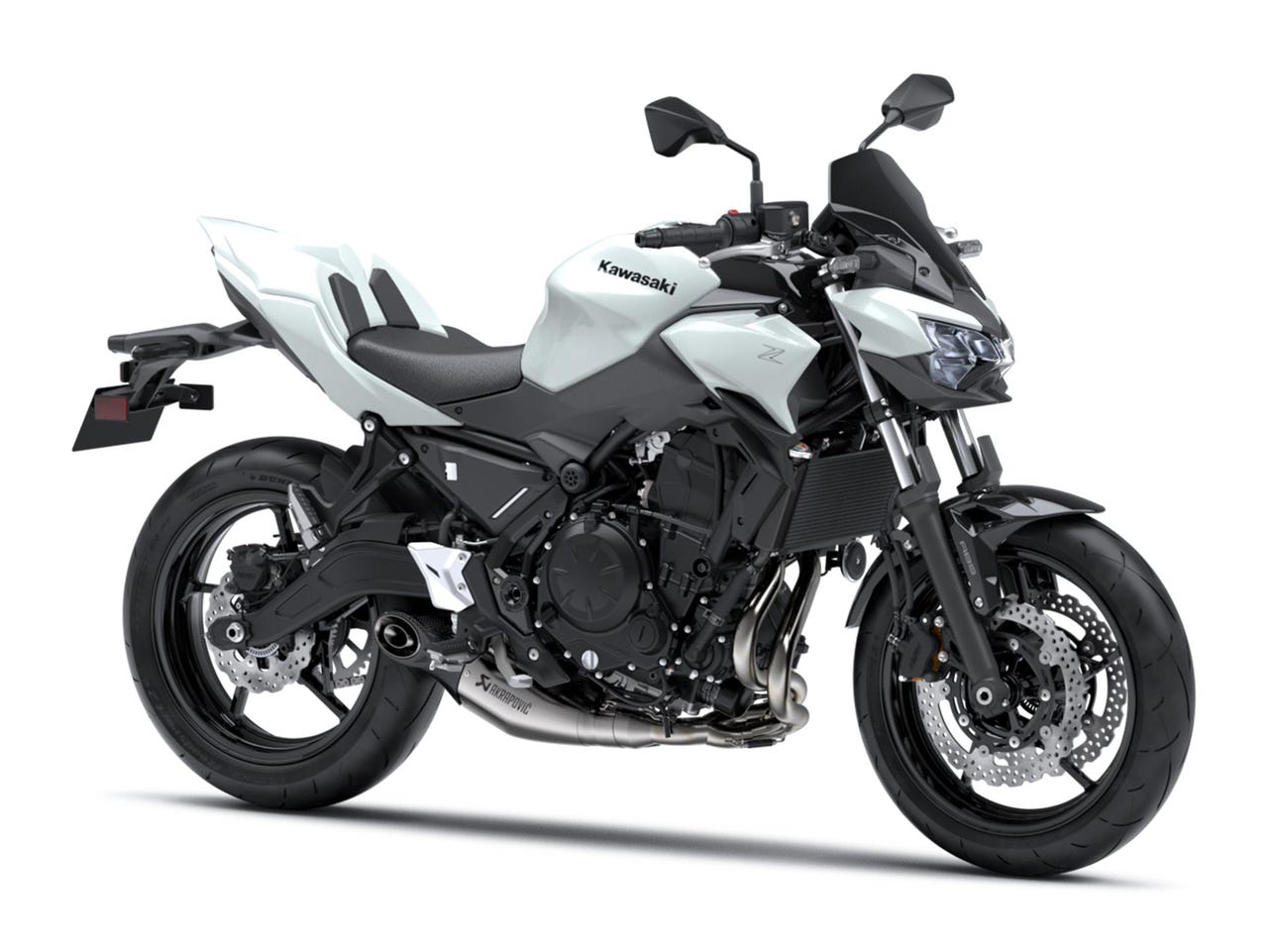
I worry that motorcycling won’t survive the combination of Cautious Mommy’s Boys and Cautious Poky P-Twins. Either on its own would be fine, as shown by the way in which the GSX-R600 used to turn frightened young servicemen into either authentic studs or authentic statistics, or the way Mini Danger Girl treats a Ninja 500 like a rented Lime scooter. But when we put low-voltage men on low-wattage motorcycles, the result of that equation is too often What’s the Point Of This?
Don’t let any of this dissuade you from buying a p-twin as your first motorcycle. As Milton’s Satan once said,
Better to ride on a p-twin
Than drive with a V-12.
And as Henry V once told us the day before Agincourt, the men who sit in McLarens hold their manhood cheap when a kid on a Kawasaki Z650 pulls up next to them. Any bike is better than no bike. But once you have that first bike, make sure your dealer, and your manufacturer’s social media, know that you want more. We want the return of inline-fours, V-twins, L-twins. Even a freaky triple like the Yamaha XSR900. We want character, we want variety. Motorcycling is, inherently, an affair of the heart, not a result of a calculation.
As for me? Well, I just spent $710 on new tires, sprocket, and chain for my SV1000. I’m going to ride it until the engine blows up — or until someone makes another Japanese sporting twin of similar minerals. And Mini Danger Girl? She says she wants something faster. A lot faster. When she says that, I act like I haven’t heard her say it. But I think a Ninja 1000 might be just the thing. 142 horses, plenty of room. Perfect for a young lady. Which means Not Enough For You, dear male reader of a certain age.
No worries; they still sell the Hayabusa, and long may it ride. Maybe one day they’ll sell the GSX-13TT. I don’t know many they’d sell. I know they would sell one.
I should say alleged attempted fingerer, the allegation was, if I recall correctly, that he locked the woman in the room with him, prepared his finger for the attack, but then was unable to actually… you know what, let’s just forget I mentioned it, I’m sure none of it is true.
In 1970, 1.1 million motorcycles were sold to 204 million Americans. The most powerful mass-produced bike had 67 horsepower, but the median was probably around 35-40hp. They were approachable and cheap, and it wasn't weird or rebellious to commute to work on a bike. These bikes are too slow for modern interstate speeds, but they met the need of the time.
I hate parallel twins as much as the next guy (with the exception of the CP2 Yamaha motor and some of the big bore 2016+ Triumphs), but these things are tractable and powerful enough to conceivably be someone's first bike AND their second bike. Hardcore CP2 owners regularly get 100k+ miles (if you don't wheelie it) out of their bikes. In an era where disposable income is nonexistent and nobody works on their own shit, 24k valve adjustment intervals are absolute magic. They're the right motor for the era, and they can be pretty fun in the right chassis.
The goal is more bikes on the road. I don't care if they're powered by singles or twins or fusion reactors that run off racial tension. It's hard to imagine motorcycles pivoting from their current status as tools of antisocial personality disorder to one of daily use by average Americans, but I think everyone on the road would benefit from it. Saturation is the only way these objectively stupid machines are going to escape the banhammer over the next twenty years, and I think the P2's might be the ticket.
I would argue that it goes something like this:
The longhoused redditors do seem skittish of anything more powerful than an R3;
But those redditors were longhoused by someone - namely Munchausens-by-Proxy/BPD moms... And the ones who let those moms get away with denying their 10 year olds a CRF110 were the dads.
The dads, reluctant to piss off mom, are where the buck stops.