

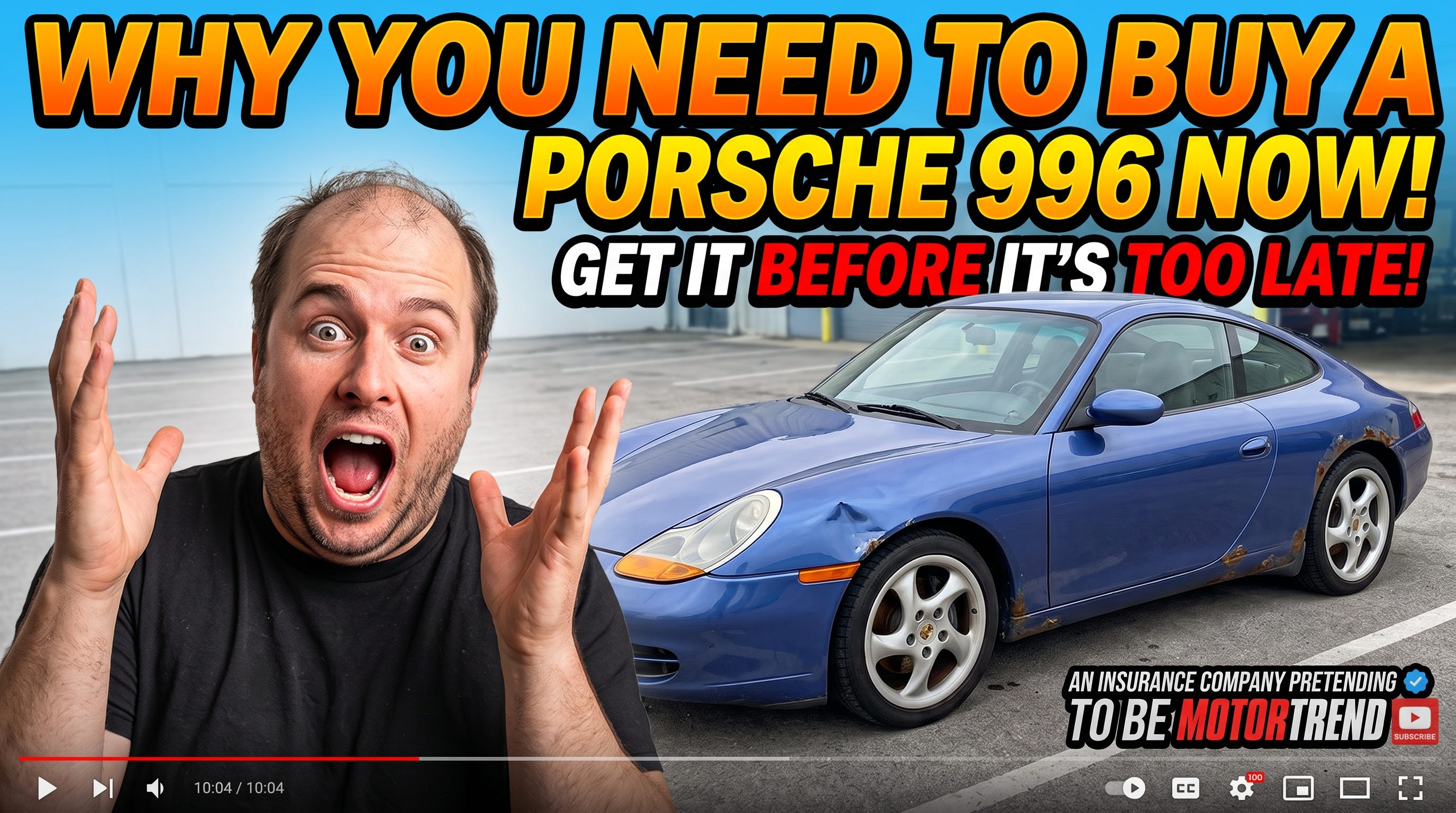
Not to get all philosophical in an article that will mostly be about Playskool plastic ashtrays, Toyota-Camry-level performance, and online auction pimps, but: The story of humanity is largely a story about people learning the wrong lessons from something they’ve just witnessed.
Example: There was an absolute explosion in the electric-guitar market from 1958 to 1965. No one has all the numbers, but total sales in 1965 are generally thought to be between five and ten times what they were in 1958. One effect of this was that the best guitar makers of the day rapidly expanded their production facilities and, in the case of Gibson and Fender, were bought out by larger corporations anxious to get on board with the latest fad.
In 1968, the electric-guitar market collapsed as people switched to acoustic guitars and folk music. The corporate owners of Gibson and Fender responded by cutting costs, using cheaper materials, and speeding-up assembly. This lowered quality, which had already taken a serious knock thanks to the previous ramp-up in production. Plenty of musicians, most famously a young Eric Clapton, spoke out on this topic. So by 1975 or so there was already a perception that “vintage guitars”, meaning guitars between 10 and 15 years old, were better than new ones.
By 2000 or thereabouts, most new American guitars were back to being of “Sixties quality” and today some of them are arguably better. So if you buy a new guitar, you should be totally satisfied. But the lesson people took from this catastrophe wasn’t “the 1959-1968 guitars are great” but rather “old guitars are great”. So you can walk into a fancy guitar shop right now and see a 1975 Fender bass selling for four times the price of a new one. Even though the 1975 Fender bass is probably not as good as a 1963 Fender bass or a 2026 Fender bass. The resale industry, and the music press, has convinced people that merely being old equates to being good. That is the wrong lesson!
One more time for the people in back: a 1964 “vintage guitar” was originally valuable because the 1970 guitars were awful. Therefore, it’s bad comedy to put “vintage valuation” on the junk that made “vintage guitars” worthwhile to begin with!
If you’re a Porschephile of long standing, I think you know where I’m going next.
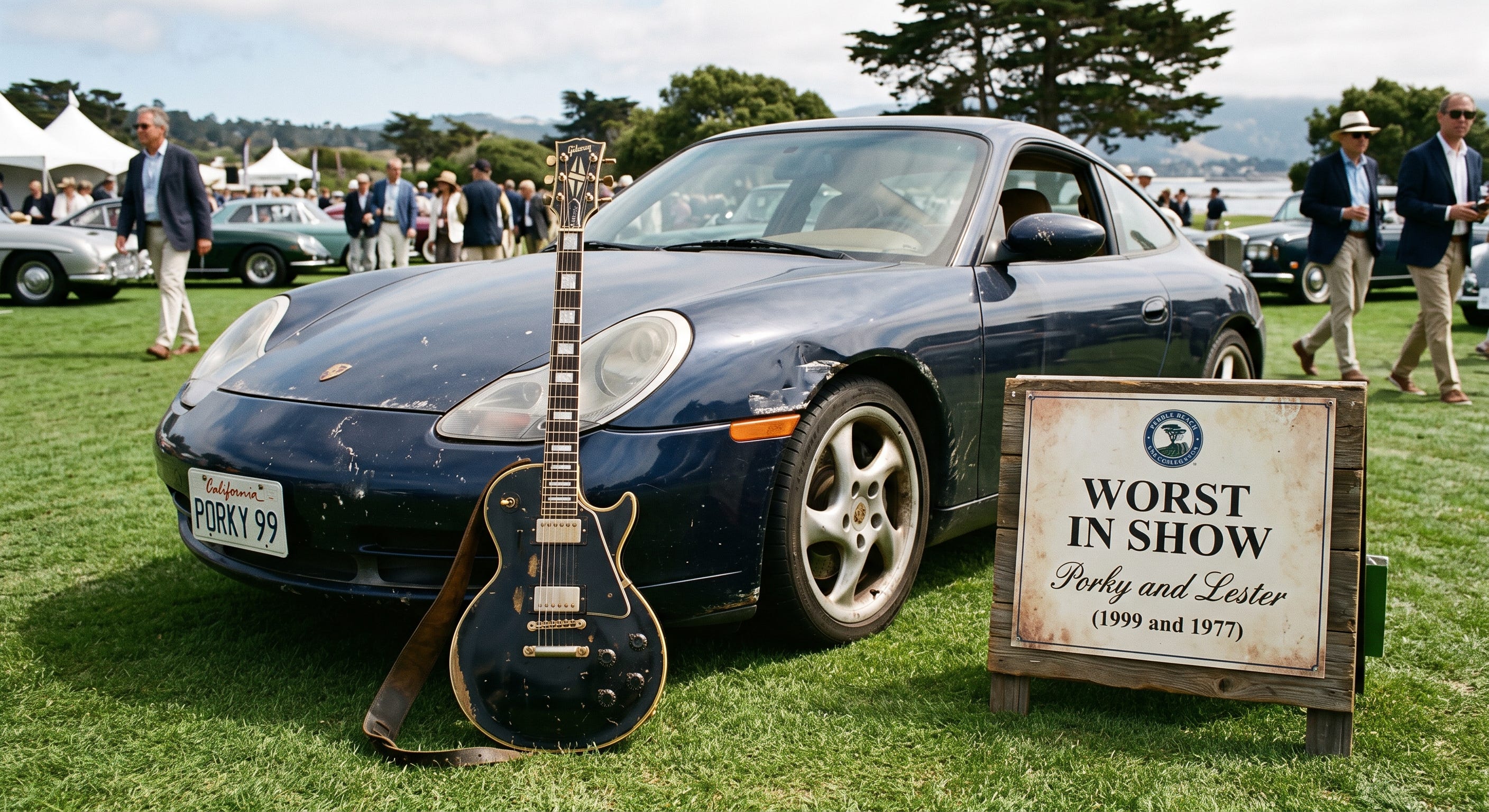
This is the part of the article where I confess that, despite all of the above, I really like 1970s Gibsons. I once drove basically across the Midwest to get a mint-condition 1979 Gibson Explorer in pearl white. Very Def Leppard. I am always a buyer for Seventies stuff — but I don’t pretend that the average “pancake Lester” from 1974 is better than a 1959 “Burst”, because it isn’t. Nor would I suggest that a young musician play a Seventies guitar to start his or her career. You’d be handicapping yourself if you did that.
Similarly, I understand that the 1999-2004 Porsche 911, aka the “996”, has some genuine appeal to some buyers and owners. If you own a 996 and you adore it, then more power to you. Somewhere out there is an owner who is deeply sentimental about his 1999 Arctic Silver Tip Cabriolet Carrera 4 with zero factory options and that awful grey interior that makes it look like a base Boxster inside. I celebrate that owner and would love to hear all about his car…
…but if you’re thinking about a 996 for the purpose of “getting into Porsches”, or buying your first Porsche, then
before you let the scumbags in the insurance and auction and advertorial-media games bamboozle you into buying what is probably the worst boxer-engined Porsche ever built.
Want an example? Let’s hear from the pimps at “Collecting Cars”. Keep in mind that “Collecting Cars” is not an impartial source. They are not the media, even. They are a front for an auction. Their job is to extract the most amount of money from the marks and suckers — that means you. And when it comes to the 996, butter wouldn’t melt in their mouths:
the 996 is now celebrated as a lightweight, analogue, and highly communicative sports car. With its narrow body and hydraulically assisted steering, it offers a pure driving experience that many recent successors lack.
All of that is equally true if you apply it to the Mustang II, which weighed less than a 996. And who, precisely, is “celebrating” the 996, besides the auction houses and insurance companies who are trying to raise the prices? Let’s see what else they have to say:
Prices for the 996 reflect that they have transitioned from just being considered ‘a cheap 911’ to being a respected modern classic.
Yeah, you fuckin’ wish, you dirtbags. You earn your money as a percentage of sale price. Now let’s hear from my former employer, Hagerty, who hired Panorama editor and long-time Porsche-pimp Rob Sass to talk the pig up:
Overall, the 996 remains the best way to get into an analog-feeling, right-sized 911 at an affordable price. It’s not without its flaws, but if you’re careful about what you buy, it can be an extremely rewarding and very usable car for the price of a lightly optioned Corolla.
I have an agreement with Hagerty regarding how I discuss the company in public, so I will merely suggest that I disagree with the article and that the costs involved with owning a Porsche 996 are very far from away the costs of owning a lightly optioned Corolla. Anyone who took this article seriously and acted accordingly could stand a very good chance of finding themselves in a bad place. Also, check this, from the same article:
Aero kit cars are desirable and generally priced at least $10,000 more than non-aero cars.
I’m sure. This is a 996 with the Aerokit:
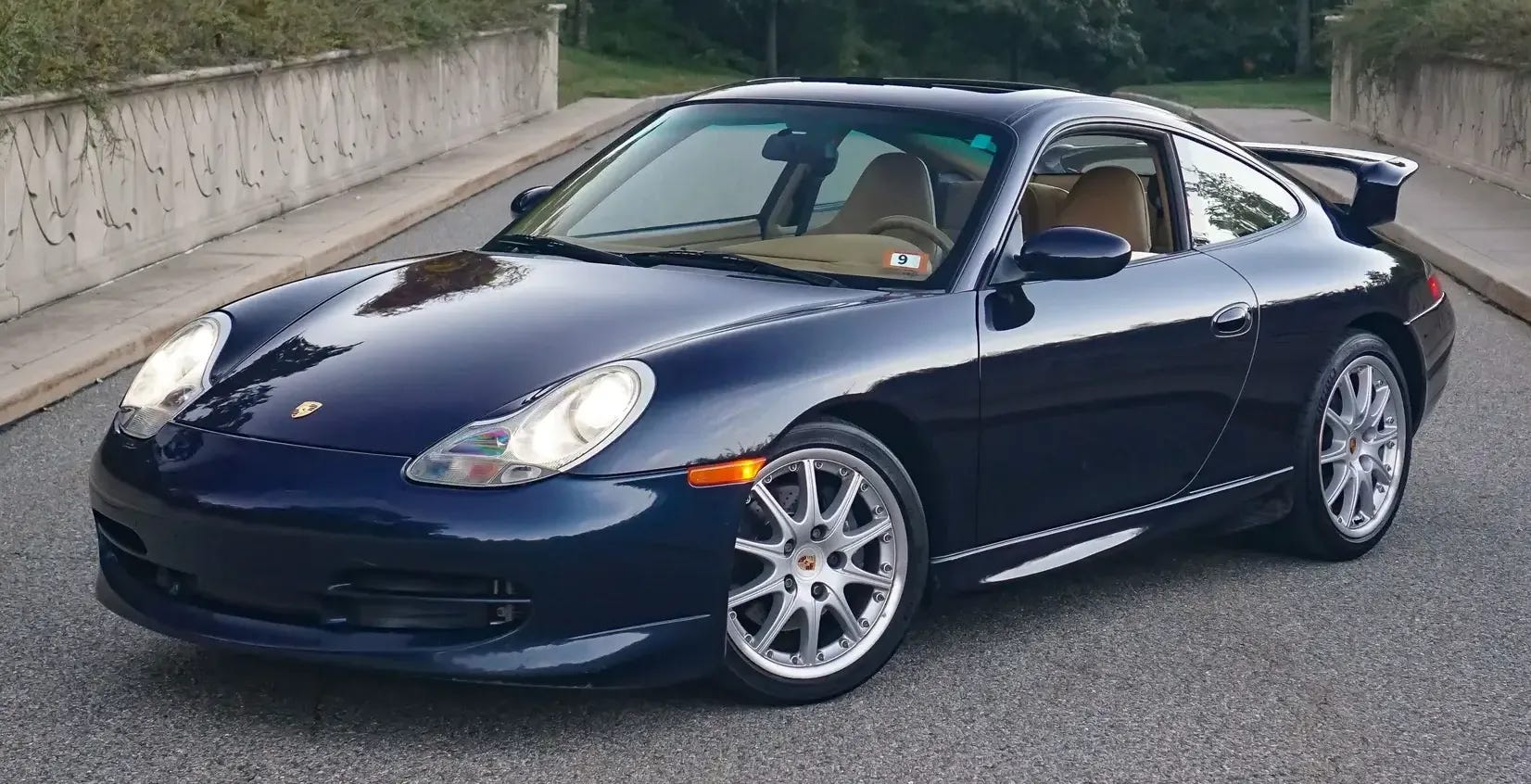
That’s the best photo you can take of it. You should see one on the street. It looks like a cross-eyed toad.
Here is the truth of the matter: Prior to 1998, every Porsche 911 was measurably better than the one that came before it. Because Porsche was a small company working at the edge of its limited capabilities, each model tended to have some awful mechanical disaster waiting for an unlucky owner: fragile 915 transmissions, magnesium cases, SC chain tensioners, valve guides in the 3.2 on, 964s with no head gaskets, 993s that won’t pass emission checks without $28k of engine work, and so on. But you could trade-in your 911 every few years and have some confidence that the new one would be faster, more comfortable, and more reliable. The apex, pun intended, of this progression was the 993 generation.
The 996 was a big change, and although it was nominally better in various statistical categories it was also obviously a piece of shit from a subjective standpoint. The car looked dorky. It had frameless glass and the doors felt like they were made from cardboard. The interiors were dismal and would wear shiny almost immediately. The engines had a couple different ways they could go kaboom and the only remedy Porsche offered for a very long time was a complete swap to a remanufactured unit, like their $69,995 premium grand touring 2+2 car was a used iPhone or something. To make matters worse, BMW released the E46 M3 very shortly after the 996; the Bimmer cost 2/3rds as much and could put the Porsche on the trailer in every category from quarter-mile time to road-course performance while also looking more premium both inside and out. I have several of the road tests from that era; you can feel the writers trying not to accidentally cancel their future media trips to Stuttgart as they discuss the massive edge the M3 had on the 911 in all areas.
Compared to a 993, the 996 was cheaper-feeling and less involving to drive. So more of them were sold as automatics, cabriolets, and the “ultimate” 911, the Carrera 4 Tip Cab. Almost immediately, people started in-hindsight re-evaluating the 993, which felt like a much higher-quality car and didn’t require you to repeatedly swap the engine with a remanufactured unit.
In other words, the Porsche 993 was a 1959 Les Paul — rare, beautiful, made carefully in small numbers — while the 996 was a 1973 Pancake Lester — overproduced, made from cheaper materials, aesthetically a bit suspect, not reliable to own. So the former picked up value while the latter become de facto worthless.
Your humble author bought a 993 back in 2001 for twenty-nine grand, when it was just a used Porsche. I put about 70,000 miles on the car across the space of two decades, always treating it like a used car. I left it on the street in downtown Nashville and Cleveland, autocrossed it in something like fifty events, went through nine sets of rear tires. One day I woke up and it was worth something like $125,000, which terrified me so I promptly traded it for a $125,000 race car.
That wasn’t the whole story. I was also disgusted by the sheer number of friends and/or peers around me who had adopted the 993 and its lesser predecessors as part of a “drive tastefully aesthetic” that was curated and snackable and performative. A car that for me had long been a “let’s drive down to the local dive bar for six shots of the cheapest, then bump over a curb on the way out” hooptie was now the touchstone of a deliberate and bizarre lifestyle that included everything from Rolex GMT-Masters to craft beer. A whole culture appeared out of nowhere, led by the Luftgekuhlt loofa-cult, and the entire message of the culture was
Every water-cooled Porsche is trash, but these old ones are great!
Not entirely untrue. The cars did get better from 2005 on, and some of the 1999-2004 cars were supplied with an engine that didn’t go pop, but all things considered it was safe to say that Porsche’s new products didn’t excite people like the old ones did. Meanwhile the Corvettes got faster and the M3s got more power and the world kind of shrank around Porsche.
Faced with this problem, the company responded brilliantly by just paying everyone off. The Loofa Cult people were strongly incentivized to bring out “Air|Water”, which takes the nerdy, cringeworthy reverence shown by the “culture” to my old beater-bitch 993 and transfers it to the newer cars. Magnus Walker reportedly was cut a few checks to get publicly excited about water-cooled Porsches. The press trips became even more elaborate, even more indistinguishable from bribery. God knows how much they spent; one of my colleagues at Road&Track, if memory serves, got a week-long trip to Germany where he lived like a king which enjoying a “curated 911 experience”. In one of history’s great switcheroos, Porsche managed to take the reverence everyone felt for the 993, a reverence born from the fact that its successors were junk, and transfer it to those same junky successors. It was the equivalent of celebrating the 1975 Fender Strat as a “vintage guitar”.
Which created an interesting situation. All aircooled 911s are now worth stupid money; the trashed 911SCs that used to change hands for ten grand are now crossing auction blocks for fifty, while the cars before and after them are worth even more. Meanwhile, a combination of complicit media, quantitative easing, and Instagram-driven male insecurity has made recent 911s almost depreciation-proof. So if you want to become a “Porsche guy” at a budget beneath “hedge fundie”, what options do you have?
When I was thirty years old I had hundreds of cheap aircooled 911s in Ohio from which I could choose, from $5,000 for a 911S to $45,000 for a good 993 Turbo. (!!) Today’s young man has none of those choices. A decent 993 or even 3.2 is probably a $100k possibility, and it will need significant investment after the fact to keep running. The new cars are all six figures as well. If you’re a 30 or 35 year old bachelor and making $150k in some reasonable high-end young-person job, you’re near to being priced out of the used-Porsche market despite your success.
In your shoes, I would buy a new Mazda Miata, which is nearly as fast as a 996 in a straight line and will dust it around a road course. There’s a Miata 30AE in my garage as we speak. But I understand that a Miata doesn’t feel like an achievement to many of you, for the same reason that my advice on watches — “Get a Citizen A060 for $2500, and never think about it again” — feels like I’m pulling the ladder up behind me. Today’s cars might be fast but they often feel fake and sterile and big and chunky.
I also understand that Porsche’s limitless marketing budget, like the limitless marketing budget of Rolex, has convinced a lot of young men that they need to own a 911 for purposes of ego reinforcement and group identity. But a new 911 is too hot to touch. So the pimps have joined forces to convince these young men that they should look at the 996. It’s the most affordable route to Porsche ownership!
(Left unstated, because it’s an impossible case for sane people to make, is why, exactly, anyone needs to own a Porsche nowadays. It doesn’t impress women and you’re perpetually at risk of being 40-rolled into obscurity by a $54,000 Tesla.)
This new tidal wave of 996-centric YouTube videos and auction marketing disguised as buyer’s guides is designed to lift everyone’s boats. Higher prices on 996es help the used-Porsche dealers and auctions. Higher valuations on 996es force more owners over to specialty insurers. If the cars are worth more, then they become worth repairing, which is good news for the aftermarket vendors. Your local Porsche Club wouldn’t mind having more paying members. The people who own new Porsches absolutely adore the 996 guys, because they’re like a captive and highly envious audience; think of a new GT3RS owner as Anne Hathaway on the red carpet of the Met Gala and a 996 Tip owner as the poor loser who buys a ticket to stand in the shadows and watch her walk by.
Everyone’s a winner — except you, the prospective 996 owner. You’re being asked to pay $30,000 or more, the price of a new Miata or Camry, for a car that truthfully will struggle to keep up with either of those cars in a lot of situations while also requiring an insane amount of repair and maintenance.
When I paid thirty grand for my 993, I had the satisfaction of driving a mint-condition five-year-old 993, which was neat. When you pay thirty grand for a 996, you will get a sad, climate-scarred car long into its third decade on this planet. Even the buyers’ guides admit that the interiors can literally turn into dust after being touched too often. The paint will be thin. Every piece of rubber in the car will probably need replacing. It will not drive like a new Porsche. It won’t even drive like it did in 1999. Extreme age tends to blur the individuality of a car the way it blurs the difference between men and women; a beater 911 has many qualities in common with a beater Mustang, from “what’s that noise?” to perpetual oil spotting. If you put twenty grand into revamping the suspension, including every bushing, then it might drive like a new 911. Kind of. At which point you’ve got fifty grand in a car that probably runs fourteens downhill.
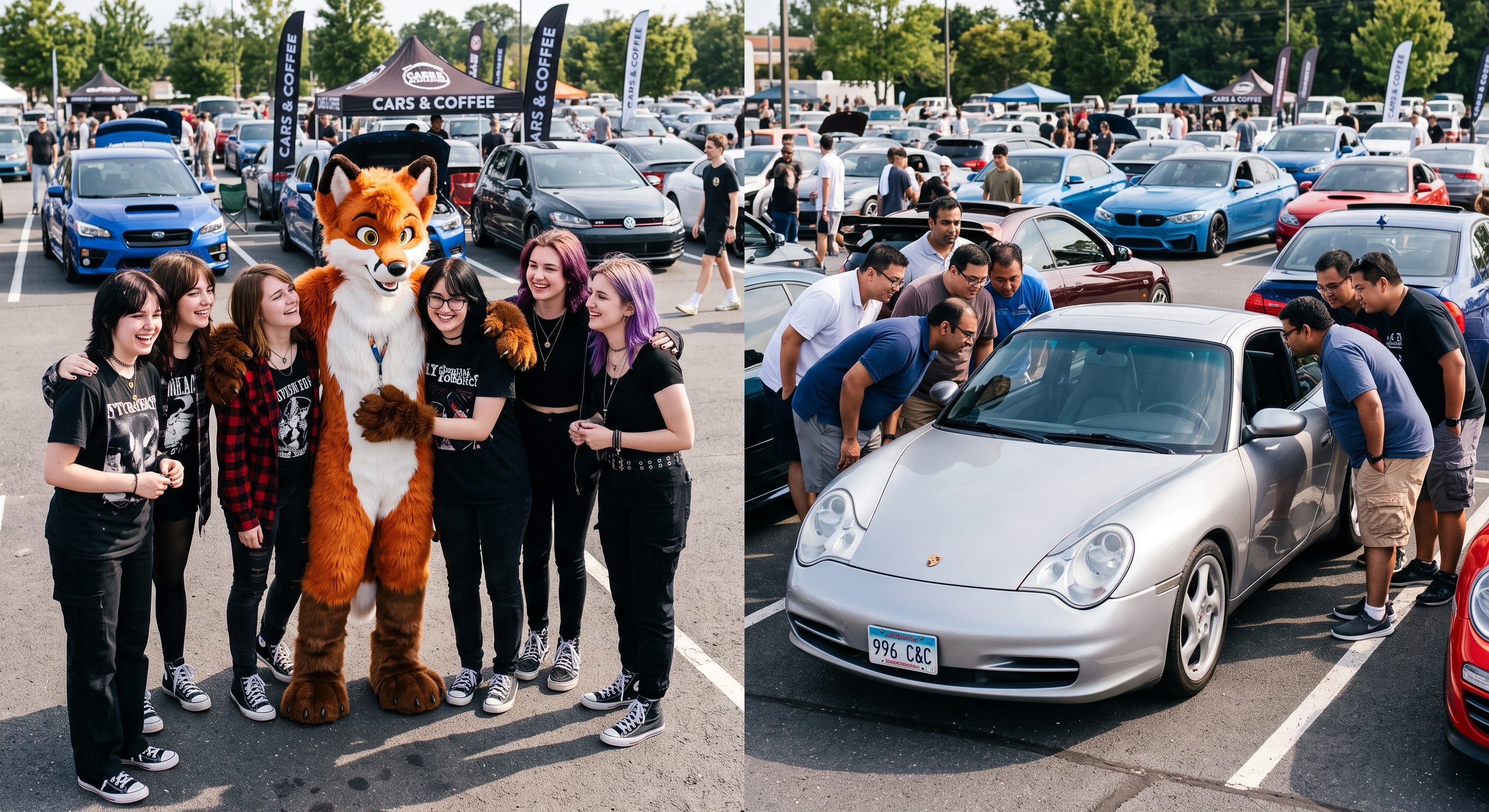
And what does it do for you? Make you the junior member of your local PCA chapter? Give you something to drive to Cars and Coffee, where you will be made fun of behind your back? Put you on your local racetrack where you will spend the entirety of every session with your left hand out the window as Spec Miatas and Cobalt SS Turbos blow by you?
If your love for the Porsche 996 is like my love for the 1977 Cutlass Supreme — irrational, nostalgia-driven, idiotic — then go ahead and live your dream. But if you’re about to overpay for one of these sleds because you think you’re going to enjoy defining yourself by joining a “community” made up of Drive Tastefully nerds, then let me suggest that you become a “furry” instead. Not only will your weekend outfits be less cringeworthy, you might even accidentally meet a girl.
It’s easy to criticize someone’s actions without offering a solution, so let me suggest a few alternatives to the ownership of a $30,000 Porsche 996:
Supercharged NC Miata ($20,000) and 2013 GSX-R1000 ($10,000): The first half of this pairing will eviscerate a 996 in every way imaginable except for a bit of perceived appeal to the opposite sex, so we will hedge our bets by including a Gixxer Thou. There is no Porsche driver in the world, not even the GT2RS Burgerking Edition owner, who doesn’t feel a little soft when he is next to a GSX-R1000. And there is no non-gold-digging woman in the world who doesn’t think a Gixxer owner is more appealing than a Porsche owner.
The worst 911SC on Bring-A-Trailer ($35,000). This car will be a “fright pig” when you buy it. But if you put $50,000 into it, then you will have a very nice “real” 911, while putting $50,000 into a 996 still leaves you with a 996. Plus you can be a Porsche snob, which some people really enjoy. It also is probably just as likely to get you to work as a 996 would be.
An E46 M3 ($17,000 to $40,000). Back in 2001, this was a better car than the 996. You know what? It still is.
A 2011 Boxster S “987.2” ($30,000 to $40,000). It’s faster than a 996, it’s more reliable, it’s nicer inside and out, it’s a decade newer. You will still need to say a “Hail Mary” and get an early jump if you’re trying to beat a distracted woman in an Escalade to the next open spot in freeway traffic, but at least you won’t have to touch a single 996-era Porsche switch or knob. This is a better car.
2012 Corvette Grand Sport ($35,000). Might cost you a little more to buy, but it will cost you less to run, and it is blindingly faster in all circumstances.
A new BR-Z, GT86, or Miata. This is the smartest option, really. Get a car with fresh bushings and a factory warranty. Then go write your story in this car instead of spending the next five years cleaning up after some lazy douchebag who didn’t want to pay for a belt service in his Porsche.
A $15,000 F-150, a $3,000 trailer, and a $12,000 race car. A VW-powered “Formula First” turns a better laptime at most tracks than a 911 GT3 and it starts at $8,000 for a good used example. You can get a used SCCA race car for ten grand in pretty much any category south of Prototype 2. If you want to be about it, then be about it. I assure you that as the owner of a final-generation Radical SR8, in which I lap 997 and 991 Cup cars during club races, I never, ever, ever wish I could trade it back for a 993. You could have the same experience, minus the engine rebuild costs and the occasional 155-mph horsefly to the visor, with an Improved Touring sedan.
This was a long column. Thanks for reading. I hope one thing is apparent: I want you to have the same kind of fantastic and memorable experiences behind the wheel that I’ve had. They won’t be the same experiences. We can’t turn back the clock to the days of cheap aircooled cars (or cheap Vipers, or cheap C6 ZO6 Vettes, and so on.) But we can make smart choices that will allow you to have the time of your life in the car of your choice. Whatever you choose, I wish you the best. And if you buy a 996 despite all of the above, then I have two things to say:
Congratulations. Enjoy the heck out of it.
I’ve been behind you in this Miata for the last eight laps. Move the hell over!
People who buy a collectible anything on the advice of some fat doof who likely lives in a 230 square foot apartment in some trashy metropolis like NYC, who owns not one car, and gorges on shrimp and praises some crappy new Kia combover in return, deserves whatever pain that results.
Baruth the Truth Teller!!!
Hell-to-the-FUCK YEAH!!!!!!
You, Sir, constantly amaze me with the TIMING of your topics as much as the topics themselves. You truly are tuned into the zeitgeist, my friend.
Everyone here already knows I own a 2004 Boxster “50 Years of the 550 Spyder Edition S” like you used to own. And everyone here knows I own a first gen Ducati Monster and used to own a Nicky Hayden Edition Honda RC51 SP2.
Sooooo, having just driven said Boxster from my Louisiana home to Monterey, California for Car Week, and having just entered the Porsche Club of America “Werks Reunion” concours event and shown my car “on the lawn” of a golf course, I have sooooo many thoughts on this column.
My first thought is, you are absolutely, 100% correct on all of the above.
I am 58 years old. I have never made any real money in my life. For the first half of my life I was a newspaper photojournalist and never made more than $30,000 a year. Gross.
When the NA Miata launched in 1990, I was a starving 22 year old. I grew up reading “Side Glances” and had to have that Miata. Somehow I was able to buy a brand new one in 1993 and I owned that Miata for 22 years and put over 325,000 miles on her. My brother bought a 1990 Miata with a Flyin’ Miata turbo kit on it and I ended up with THAT car, too. I put 270,000 plus miles on that turbo Miata.
My wife and I drove both of those Miata’s all over the country. We drove the turbo car to the top of Mt.Washington, both cars to the top of Pike’s Peak, from coast to coast and Mexico to Canada we drove. In an NA Miata.
I attended many DE events in those Miata’s and burned uncounted numbers of RA-1 and AO32 “R” compound tires and hit many rear bumpers on 360 Modenas who refused to let me pass in the turns.
While I have only competed in one wheel-to-wheel race, I appreciate your racing background and am envious of same.
I then overcame my fear and at age 38 I learned to ride motorcycles and bought that Ducati Monster.
When I saw the writing on the wall that photojournalism would become a dead end career, I started selling cars in 2003 for lack of a plan.
I was sitting on “The Point” one day, waiting for an “Up” and reading Road & Track. There was this news item about a new limited edition Boxster that would celebrate the 550 Spyder and I looked at the photos of that car, and saw the price-$64,000. I cried.
Seriously.
I am a grown-ass man now and am among friends here, so I freely admit that I cried. I cried because as a new auto sales consultant in a pissant town in the middle of nowhere Louisiana, whose entire career that he started in high school and attended the University of Texas for a degree in, was now over, and I was working my ass off, 10 hours a day, six days a week, with only Tuesdays off, and making about $35,000 that year, I thought that I would NEVER be able to own that Boxster. I thought I would be a Miata man forever.
Not that there is anything wrong with that, but man, I thought that Boxster was just the most beautiful car and I really wanted a mid-engined, two seat, convertible sports car.
What were the choices? Boxster, 360 Modena Spyder, Toyota MR Spyder, or some crazy exotic. That was it.
I ended up becoming a great car salesman. I started making money. I doubled my income. Suddenly I am making $60,000 a year. Amazing.
Then in 2008 I discovered a world of technical training. I could get paid to teach salesmen about cars for the manufacturers. Who knew?
I could see the crash coming. We were slinging cars to people who had no business buying them. 84 month loans for used Tundra V6 steel wheel flareside pieces of shit. I was making huge money.
And I knew it was all about to collapse.
I ejected. I got a job launching the original VW Tiguan. I got paid $100,000 to travel around the country and teach classes to sales people about cars. Amazing.
And I was on the road when Lehman Brothers collapsed.
I never lost my job. I ended up with a Big Three car company and have been launching every new vehicle they make ever since and am doing it today.
In 2015 I bought that 2004 special edition Boxster. Found one with 25,000 miles on her.
We drove her to Monterey for Car Week and back, 4,500 miles, across 116 degree Arizona and the car was a champ.
I ABSOLUTELY LOVE my 2004 Boxster and will never, ever sell her. She is my “Forever” car. It is EXACTLY what I want a car to be. I love driving this thing. Just love it.
Soooo, I have never been a car show guy. But as your column discussed, I am “in the club” with Porsche ownership.
I figured I had to see Car Week once in my life. My wife is retiring from her job in September. I booked a condo on the beach in Monterey Bay and we made a vacation of it.
I wanted to see and hear the 4-rotor Wankel Mazda787B LeMans prototype run at Laguna Seca.
We saw and heard everything. I stood next to the exhaust outlet as they warmed her up and that rotary blew my eardrums out. Glorious.
So I got to see classic cars on track, in the paddock, and spend time with my wife on the beach.
Entering the Porsche show was just ticking a box of “while we are there, why not” sort of thing.
I’m glad I did it. Once.
I have no desire to enter a car show EVER again. But I can say I’ve done it now.
All the kids in there 20’s and 30’s approached me about my car and asked a million questions because that either had a Boxster or were thinking about buying a Boxster because of the very same market boosting hype you wrote about.
I am soooo glad I bought this car when I did in 2015. The car market is just insane now
You are absolutely correct on maintenance costs for these cars.
I have spent ALL the money on preventative maintenance and have addressed all the failure points on these cars.
I have an “IMS Solution” bearing in there, I installed the ROW M030 suspension two years ago and replaced all the control arms and bushings.
She has new axles, wheel bearings, brake calipers rebuilt, dual core aluminum CSF radiators, yada yada yada.
I have put 70,000 miles on this car. She is sitting here at 97,567 miles.
I can’t think of any car that could replace this car and make me any happier. Not one.
So, I am going to keep the stupidity going, and I am going to drive this thing to my engine guru in the mountains of Georgia and have him build me a killer engine.
Is that smart? No.
But I will be dead one day, and having this car with another 100hp appeals to me.
I hate all the Porsche wankers. I hope I don’t fall into that category.
I’m just an old guy, with a car he loves, and it happens to be a Porsche Boxster.
But I’m not sitting at a cars and coffee bragging about “my spec” and my “sick deviated stitching” like the Porsche wankers I despise.
So for all my fellow Avoidable Contact compatriots out there, if you are not a part of the Porsche world, and you are thinking about buying that 996 like Jack wrote about here, I have this advice-listen to Jack.
But if you really must have that 996, be prepared to spend as much money in maintenance as you paid for the car itself. Just double the purchase price. And if you can live with that, then go in peace.
Enjoy the drive.