

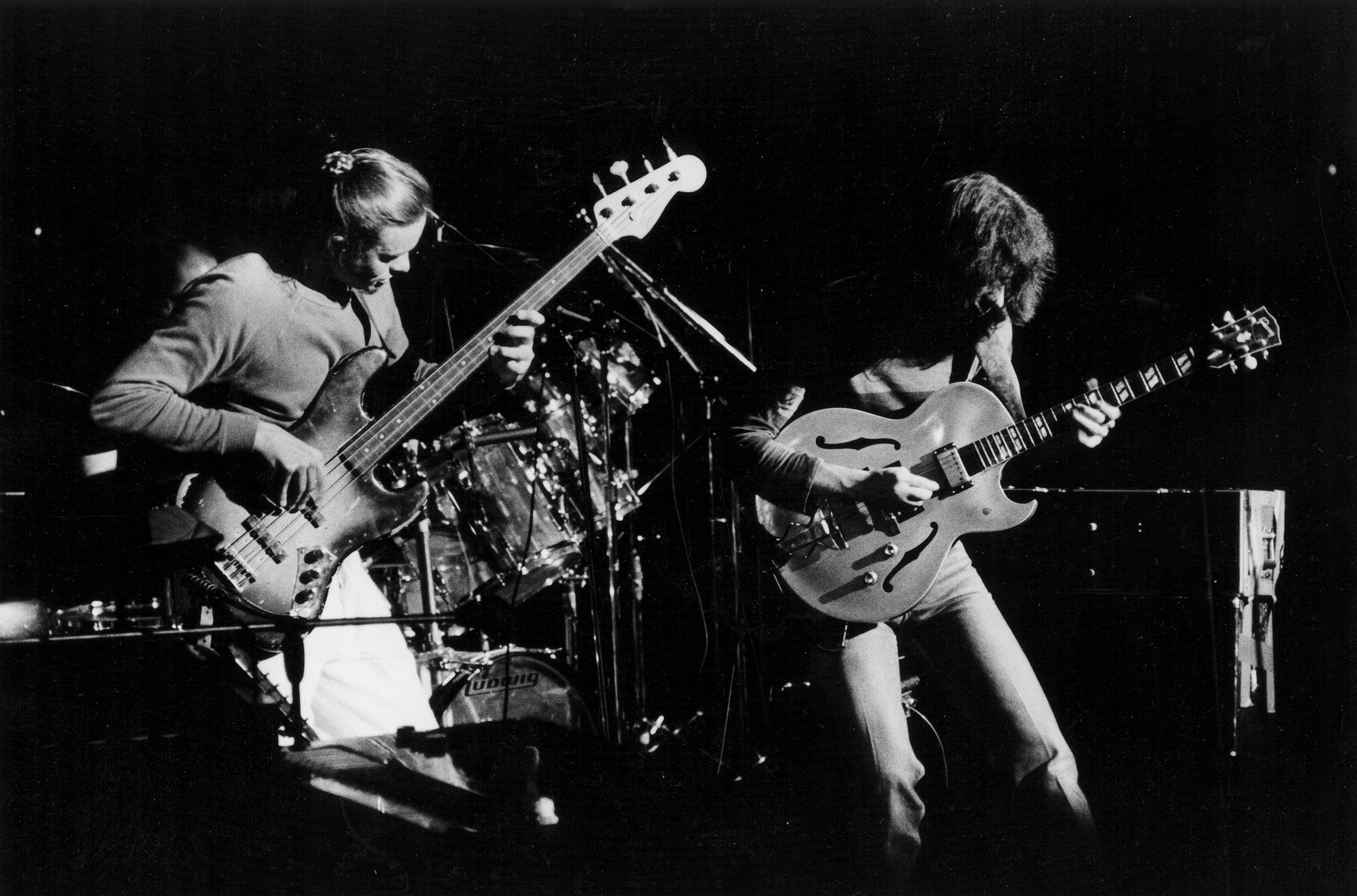
Nine hundred copies.
That’s what ECM Records managed to sell from the original vinyl run of Bright Size Life.
At the time, Manfred Eicher no doubt blamed the lack of interest on bandleader Pat Metheny’s inexplicable decision not to use Dave Holland, a respected and ultra-competent upright bassist, on the record. Instead, Metheny had insisted on this fellow he’d been touring with — John “Jaco” Pastorius III. Eicher could have forced the issue; indeed, he was rather famous for forcing issues with his talent. Instead, he backed off and gave Metheny a chance to do what he wanted. He wouldn’t make that “mistake” in the future; the succeeding Watercolors, Rejoicing, and Pat Metheny Group LPs all featured a much heavier hand of Eicher intervention, to the point where the last of those albums has an absolutely ridiculous track order because Eicher wanted to optimize a particular song on the album for the part of the record groove with the widest possible dynamic range.
Bright Size Life was a confident, almost arrogant, effort from the 21-year-old guitarist. Six of the eight songs were originals, one was an uncredited revamp of a tune from Metheny’s mentor Gary Burton, and the last one was an Ornette Coleman composition. They are all profoundly odd pieces that frequently depart from conventional ideas of rhythm and meter. I heard “Uniquity Road” for the first time when I was seventeen years old and I was gobsmacked, it didn’t make any sense to me, like watching a wheel roll down a hill first slowly, than quickly, then back to leisure:
The sheet music is frustrating in a way that modern pop can’t begin to comprehend; the title track has basically a 148-note long verse form compared to, say, the 14-note repeating verse of Sabrina Carpenter’s most unusual song, “My Man On Willpower”. At no point does Pastorius play anything like a conventional bass track; it’s either unison with the guitar or a counterpoint-style melody beneath it.
Because Eicher wasn’t a fan of spending money on long studio sessions — and can you blame him, when the records don’t move a thousand units? — you can hear Metheny repeatedly flub notes and struggle with tempo. He has frequently stated that he is essentially unable to listen to the record now because all he can hear are his mistakes. Having just put out a book that I would already like to rewrite in its entirety, I can sympathize. Jaco, on the other hand, is flawless. Pastorius really plays Metheny right out of the studio for pretty much the entirety of the record. Which is reasonable, as Jaco was four years older and had much more experience playing outside of the academic environment. It’s very hip now to talk about Bright Size Life like it was a Jaco Pastorius record featuring Pat Metheny and, uh, Bob Moses.
Don’t be fooled by that. For all its infelicities, Bright Size Life is an utter masterpiece and arguably the most important jazz record ever made with a guitar. Before BSL, the average jazz guitar record was Wes Montgomery playing octaves over Beatles tunes for Creed Taylor’s studio. Afterwards, it was Mike Stern, Lee Ritenour, Al DiMeola, and so on. Every jazzbo knows it, owns it, has an opinion on it, has probably seen most of the tracks played live.
Depending on whom you believe — ECM themselves or the music press — Bright Size Life was released either on Feb 9 or Mar 1, 1976. I tend to believe ECM, which unlike most record companies of that era maintained good records and archives of what they did and when. It is available on Spotify and everywhere else you might hear music.
The best recent version on YouTube is from the tour with Richard Bona and Antonio Sanchez, largely because Bona has the courage to solo on his own ideas instead of Jaco’s:
The worst version is clearly the one-verse version I did with The Commander last year; he has Jaco’s part down just fine — and on a fretless! — but I am running a bit behind all the way through. The Yuno Miles joke that underpins the video also became immediately stale!
In my experience, there are just two kinds of jazz listeners: people who think Bright Size Life is better than Giant Steps and people who, were they to see Pat Metheny on the street in Manhattan, would slap him with a frozen fish. You should take a listen and see where you’d fall.
I don't dislike it (and would not slap him with a fish if I saw him), but it is music I am too dumb to enjoy.
I might slap Big Bunny with the aforementioned fish.