

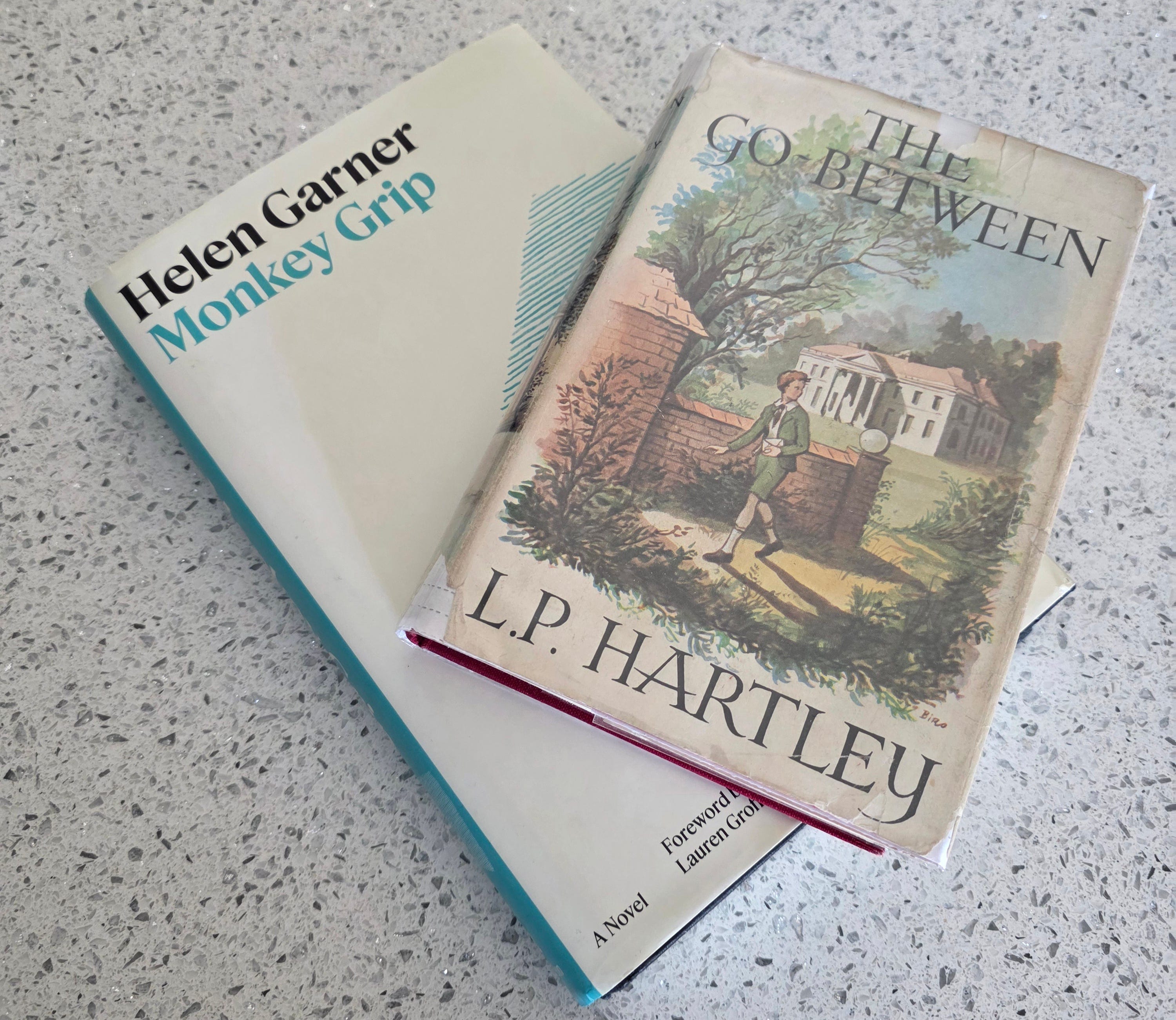
The Go-Between, L.P. Hartley, 1953
Monkey Grip, Helen Garner, 1977
“The past is a foreign country; they do things differently there.” The opening line of The Go-Between further burnished L.P. Hartley’s already sterling authorial reputation, and deservedly so. It does not hurt that the rest of the book is so skillfully done. The plot is simple enough: in the year 1952 a sixty-five-year-old man re-reads his diary entries concerning a violent and tragic trip to a friend’s country estate in the summer of 1900, then sets out to find out what eventually happened to everyone who survived. It is, at its heart, a sternly moral novel, but it is not a nostalgic one; the tension throughout The Go-Between is often generated by the hateful distance between public morality and private behavior. It aims to show that cowardice and lust and hypocrisy were just as prevalent, if not more so, in 1900 than they were in 1952.
Monkey Grip, on the other hand, was meant to be a post-hypocritical novel. It was shocking to its Australian audience upon its publication in 1977, and was widely decried as being obscene due to its graphic depiction of communal living, intravenous drug use, casual sex, and child endangerment, but it had honest intent: Helen Garner wanted to tell the entire truth about the Melbourne “hippie” lifestyle, without compromise.
(In those days, dear reader, “obscene” had a specific meaning: explicit content without artistic merit and therefore not fit for public consumption.)
What ties these books together, in a way, is their shared residence in the foreign country of the now-distant past. Monkey Grip was written almost fifty-two years ago, which is the same period of time that elapses between the 1900 beginnings and 1952 conclusion of The Go-Between. Just as importantly, those tumultuous years between 1952 and 1975 were when the educated elements of Western society made their final break from Victorian morality and turned wholly to a catechism of “If it feels good, do it.” The change was brutal in its swiftness; at the end of The Go-Between, a man might still be publicly humiliated by rumors of his grandmother’s infidelity a half-century ago, but by the time of Monkey Grip it seems unexceptional for a man to sleep in another room so his girlfriend can entertain a former lover for a night. This societal upheaval took place in less time than it took Sony to go from PlayStation to PS5. It was the greatest tearing-down of Chesterton’s Fence in recorded history, and society’s immune response to its depravities gave us everything from Ronald Reagan’s political career to “Dimes Square”.
Before considering the above any further however, let us visit that foreign country of rural England in 1900. Leo, our twelve-year-old protagonist, is a public-school boy from relatively humble origins. Frequently bullied, always unsure of himself, but also suffering from that unpleasant grandiosity which tends to manifest in smart but over-immature children facing difficult circumstances. He is invited to spend the summer at the country estate of Maudsley, a wealthy classmate. (It’s the boy’s surname, of course; then, as now, it is common for boys in a single-gender school to refer to each other by their surnames.) Well, actually it is the country estate of young Viscount Trimingham, who has two problems:
he cannot afford to maintain his own land, so he has leased it to the nouveau riche parents of Leo’s classmate;
his face was brutally disfigured while fighting in the Second Boer War.
Marian, Marcus Maudsley’s older sister, is charming and beautiful. Leo falls in love with her immediately, and she treats him like a favored pet. Everyone in the family agrees that Marian should marry Trimingham, which will unite the land and the fortune in one neat package, saving Trimingham from the embarassment of genteel poverty and the Maudsleys from the shame of being arrivistes. Leo is charmed by Lord Trimingham, who has all the admirable qualities of a genuine aristocrat and who, in reference to a query regarding Marian, tells him, “A lady can never be in the wrong.”
When Leo is asked by Ted, a local farmer, if he will serve as a “business messenger” between him and Marian regarding some details of farming, he readily agrees. Ted is charming as well, in a masculine and forthright way, and Marian's joy in Leo increases as he proves more and more useful to her and Ted. However, a chance incident reveals the nature of Ted and Marian’s “business” to Leo, at which point he resolves to handle the situation as a gentleman on Trimingham’s behalf.
It is not too much of a spoiler to note that Leo’s behavior ends up getting someone killed; the narrator implies as much at the novel’s beginning. In fact, the entire book is lacking the sort of plot-driven action that is required in, say, a modern Netflix series. The joy in reading The Go-Between comes from Hartley’s deft and delightful characterizations: of a cricket match between House and town, of a young boy’s happiness at receiving a beautiful woman’s approval for the first time, of a coward’s anger in allowing himself to become helpless.
Which is not to say that The Go-Between doesn’t raise the bar a bit from, say, the polite novels of the Bronte sisters a hundred years prior. It is the nature of literature, and society, to “progressively” push the limits of decorum and behavior until they are reset by social upheaval like that of the Victorian era (or the Reagan Presidency, to a much lesser extent.) Which is why things that might have been just hinted at in 1852 are described forthrightly, but without obscenity, in this book; when Leo sees Marian and Ted having sex in the woods, we don’t get a Tab-A-into-Slot-B description. Hartley trusts that his readers are adult enough to understand what is being conveyed.
This gentlemanly decorum is entirely missing from Monkey Grip, and that’s kind of the point. As is so often the case with first novels, Helen Garner took the plot and many of the characters from her own life; in this case, much of the book derives directly from (since-published) diary entries of her time living in a Melbourne “bohemian home” during the mid-Seventies. Nora, the thinly-veiled version of Garner who serves as the book’s protagonist, is a divorced thirty-two-year-old mother of one five-year-old girl living casually in downtown Melbourne with an ever-changing number of hippies, artists, actors, and musicians. Her ex-husband is a junkie who lives in “the tower”, which an American would call “the projects”, and she has hooked up with numerous randos at the tower and elsewhere since her divorce, but the novel opens on the day that she falls in love with Javo, an actor and visual artist who is a well-known part of the hippie community.
The American reader will chuckle a bit, I think, at the way this “dangerous” community is described. Everyone involved is young, white, and attractive; Australia in 1975 didn’t yet have the blessings of diversity which define it today. They’re all eligible for “the dole” which was $36 AUD a week in 1975, equivalent to about $250 a week USD today, so they all have money for dinners out and trips to the bar; one plot point halfway through the book concerns the fact that Nora and her daughter can’t afford a sleeper cab for a 15-hour train trip and instead have to sit in a regular seat the whole way, but they still have money to travel around the country.
Because they’re so close to Asia, they have access to cheap coke and heroin as well. Therefore, they’re all constant drug users, and the worst among them are flat-out junkies. Which perfectly describes Javo, the skeletal, mercurial, blue-eyed heart’s desire of Nora. Monkey Grip is 333 pages in the current hardcover edition but there is really ever only one plot arc, which repeats at least six times:
Nora and Javo are happy together;
Javo wanders off to score more heroin, and disappears;
In her agitation and sorrow, Nora hooks up with another fellow in the community, but she isn’t satisfied emotionally or sexually by said fellow, so she hunts Javo down and drags him home to get sober;
Javo gets sober, at which point he is no fun in bed and he won’t talk to Nora, so she allows him to get high again, and
Rinse and repeat.
Monkey Grip is heartbreaking in a way because all the connections between the characters are so tenuous, so transactional, so sad. Time and again, as well, the women basically enforce whore behavior on each other; anyone who becomes “possessive” of their boyfriend or girlfriend is ostracized from the community for being “hung up” or “not a good feminist”. There is one awful section in the middle of the book where Javo indicates that he would like to have sex with Nora’s friend, Jessie — so he goes and does just that, and Nora lies awake screaming at herself for being so insufficiently progressive that she isn’t happy about it.
Later on, when Nora is living with local rock star Gerald, Javo appears out of nowhere, fresh from another month-long heroin binge, so Gerald agrees to sleep in another room in order for Nora to have the exemplary orgasms that only Javo can give her. From the perspective of a 2026 reader, this is all deranged stuff, but that is because we all live in a society that went that far, especially among the upper middle class — does the phrase “key party” ring any bells? — before recoiling in Reaganesque horror from the edge and returning to hitherto discredited ideas of sex and relationships. In 1977, swinging and non-attachment were the cherished ideas of rich kids and the cultural upper class; today, their descendants have returned to a sort of neo-Puritan happy-marriage-no-matter-what conservativism while the trailer-trash get it on in distant, grime-and-meth-encrusted emulation of their betters’ grandparents.
Compared to The Go-Between, Monkey Grip is an unsubtle, badly paced, and somewhat pointless book — but to focus on that would be to miss Garner’s beautiful phrasing and admirably unsentimental perspective. She knows how to describe things, she knows what is important and what is not important. Rarely have I read an early novel this effortlessly accomplished, and all the more so because there isn’t really much variation in the plot to cover up any deficiencies of style. No one gripes about the novelization of Star Wars because, you know, it’s got Darth Vader. This book has a slut and a junkie, period.
Speaking of. Perhaps the most heartbreaking part of the book is to watch Nora’s daughter, Grace, become ultra-competent and ultra-perceptive as a consequence of dealing with her idiot, selfish, lazy, drug-addict mother. She reminds Nora not to drink too much. She helps her mother get over Javo and all the other men; indeed, she often manages or directs the behavior of the men when they are too stoned to function. Worst of all, Nora allows each of her lovers in turn to become intimate with Grace. Not in the sexual sense, thank God, but in the sense of faux-parenting her, and taking her on trips with Nora, and just inserting themselves into Grace’s life. This behavior, the introduction of random sex-partner men of dimly comprehended provenance into the lives of one’s daughter[s] because one is too lazy to handle the required parenting one’s own self, is the universal hallmark of a completely valueless single-mother whore and I personally despise it the way I despise the abuse of helpless animals. At one point in the book, Nora and Javo take Grace from Melbourne to Sydney, by hitchhiking. Garner describes how Javo wanders out onto the highway — you know, the one where the “road train” five-trailers-on-a-truck rigs go — at least partially strung out, with Grace on his shoulders, and I had to fight the urge to immediately toss the book into my farm’s burn barrel. I would rather read about the surprise vivisection of a random innocent bystander than be confronted yet again by the neglectful abuse of children by sex-and-love-addicted trollops who are unable to think clearly about consequences if there is a standing dick, or the possibility of a standing dick, in the immediate vicinity. We probably all know children who were forced early into maturity by a mother like this, but none of us can say we know someone who is happy to have grown up that way.
Grace, of course, is part of what we call “Generation X”, as is your author. We were there when that mighty wave of parental narcissism broke and rolled back; even if we were individually lucky enough to have dutiful and caring parents we were surrounded by contemporaries who were not. To misquote Ginsberg, I saw the best minds of my generation sitting outside on their porch steps at eleven PM because their mothers went out to get railed all night but forgot to leave the front door unlocked, and so on. Helen Garner is not unaware of the harm she and her cohort caused — Monkey Grip, as noted before, doesn’t sugarcoat those failings — but no one had any way to know just how lasting the damage would be.
Monkey Grip has no central tragic scene to match that of The Go-Between, no shocking death or eternal disgrace to offer, but if you read Garner immediately after Hartley you will be appalled at how fast Western society disintegrated, and how completely. No, this disintegration, like William Gibson’s future, was not evenly distributed; plenty of small towns everywhere weathered the moral collapse of 1965-1980 as if it simply did not exist. But that reassuring fact should not let us minimize the damage in retrospect.
The Go-Between is a story of people failing to be good in a society that did everything possible to enforce goodness; Monkey Grip is a story of people who want to be good but aren’t sure how, because their society offered them a weekly cash payout in lieu of a moral code. The former book is an individual tragedy, the latter a global one. The past is a different country; they do things differently there. But not all pasts are the same different country, if you catch my drift. So as we build the nation of this present moment, we should pick and choose wisely from what has gone before.
"the Trustee from the Toolroom" has a similar vibe to "the go-between," and while a pulp, it shows what a different world we left behind - it's a vision of the nightmare of doing the right thing
Of course, being partially set in the UK it's also just depicting the nightmare of the UK, surely one of the ghastliest places on earth
The number of "Noras" that put their daughters in spots that get them molested/raped/beaten is alarmingly high.